Monday, 6 July 2015

Arenas, Museums and Space

The length of my commute over the past few weeks have been a process of theory vs. reality.  The theory being I can get work done to and from work but the reality is having to catch connecting services and not being able to sit during peak time.  Because of this, I have thought up a new process that involves reading on the Sunday; mulling it over during Monday and putting it to paper (physical or electronic) that evening.  Hopefully this will produce content that’s on time and interesting but of course time will tell.  Anyway, I recently found myself going over some old essays and I would like to talk about one of them today.

Although I do talk a lot about ‘space’ when it comes to architectural theory, I feel it’s a nice branching topic of discussion that has a varied number of applications.  One such way is Bataille’s piece on architecture (excerpt from my old copy of Rethinking Architecture) which corresponds with this concept in an interesting way.  He talks of architecture being an expression of society through the view of official characters such as palaces and cathedrals as they impose and create a social environment that reflects their grandeur.  His comment on the duality of man and architecture reflects this saying:
…if you attack architecture, whose monumental productions are now the true masters across the land, gathering the servile multitudes in their shadow, enforcing admiration and astonishment, order and constraint, you are in some way attacking man.

The Atrium at the Tate Modern has always been a rather bear-bones environment, but it has seen host to a great number of cultural installations.  Image from http://www.wikipedia.org/ accessed 06/07/2015


His later piece on the ‘museum’ has a similar connotation in that museums are an embodiment of societies desire to contemplate and observe in which visitors are exposed to what we can be throughout the ages.  The museum presented as a ‘container’ to the ‘content’ that the visitor interacts with keeps it as a piece of architecture reflect a particular social environment (knowledge and culture predominately) as the people flow through the exhibits to reach a point where they feel more informed, culturally rounded or (as Bataille puts it) ‘visibly animated’.  To me, this correlates strongly with my previous discussions on ‘space’ and ‘place’ as the museum and its exhibits live within these two phrases; as the museum hosts the collection while the content flourishes within a relevant place before the content is refreshed.  Whether the museum is in a historic grade one listed building overlooking a grand estate or a refurbished factory, the collection (its content) is what makes a museum, a museum.  We have places like the Tower of London but we also have the Tate and together they are able to attract large numbers of visitors who are looking for a cultural experience while they visit.  It is with this thought that games in some situations follow this theory through the concept of the ‘arena’. 

Chest-high walls among a set-piece that is design for conflict.  Image from http://wikigameguides.com/ accessed 06/07/2015


In a large number of action titles, you will be moving along a path and come across a space specifically design for a set piece to happen in.  An example of this can be Gears of War, where the abundance of chest-high walls will usually signify the approach of an incoming battle.  The player moves into this space aware of what they are looking to experience, readying their senses and acting accordingly.  They battle through this set-piece then find themselves moving along another path into the next conflict which will most likely follow the same pattern, regardless of size or prestige shifts between them.  Other examples such as a large open space with weapons littered around to signify an incoming boss battle or the more direct transitions in a game like Painkiller which feature an ongoing series of checkpoints can differ massively architecturally, but still give a similar impression to the player.  It shows that the environment can be a grand vista of physics and high-end graphical effects or simply rendered street but as long as the content aligns with the player’s desire for an experience in a well versed way it can be a great thing.  Referring back to Painkiller, some the environments may look quite simple, but its deliverance of content puts it low on the player’s priority of thoughts. 
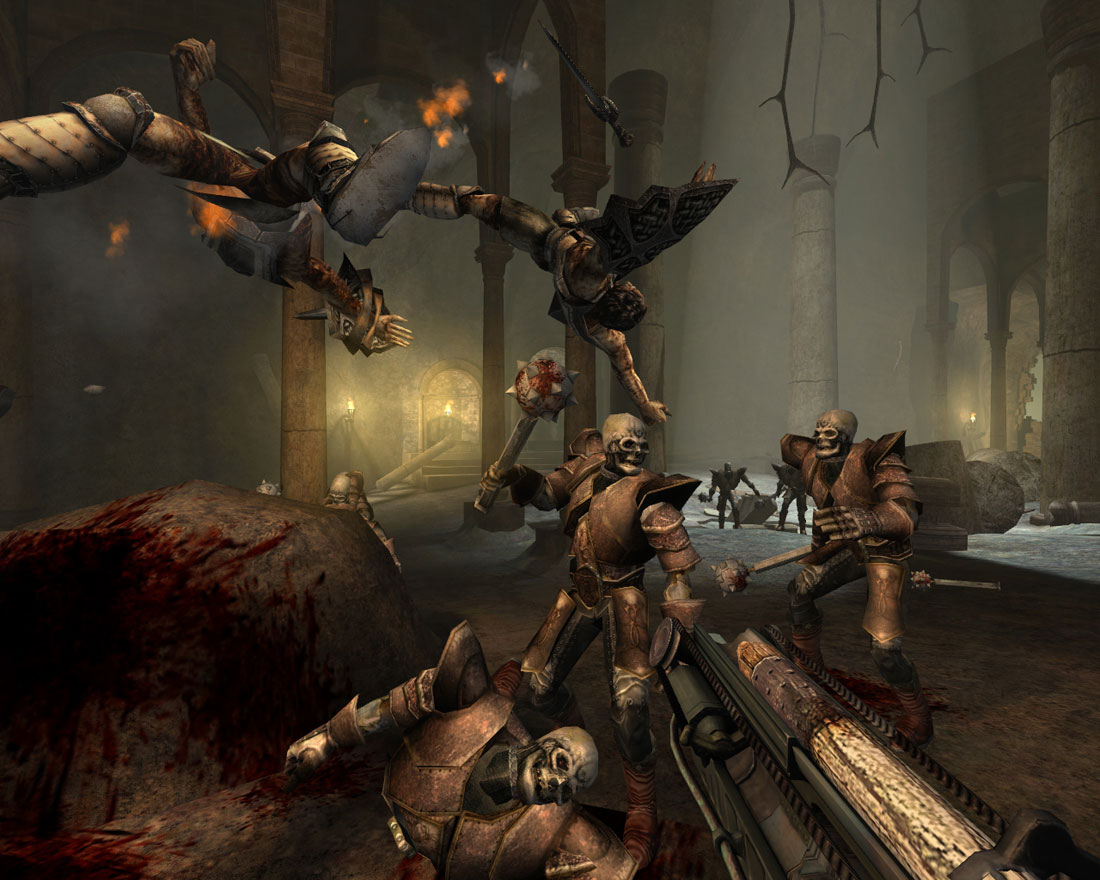
Painkiller primarily is a series of arenas, but focuses heavily on combat to create an experience the player is looking for.  Image from http://www.nvidia.co.uk/ accessed 06/07/2015


To conclude, architecture can be a grand monument as much as a hovel but creation of an experience is what makes it truly shine.  Games do this brilliantly and it shows that chest-high wall galleries can be fun if the experience is attuned alongside it.  A game where the world around me is exploding into a million little events like Bulletstorm or Wolfenstein: the New Order can give me the same feeling of an experience as a puzzle in Antechamber due to their means of presenting the game-play to the player.  


References:
*Bataille G Archtiecture as shown in Leach, N. Rethinking Architecture(2008).  Routledge, London p.p. 20-23

Monday, 29 June 2015

Lion’s Arch Rebuilt, Guild Wars 2

Last month, I discussed my thoughts on the redevelopment of Lion’s Arch as it stood in an awkward state of ruins and fortifications awaiting a shiny new look via the in-game organisation called “The Consortium”.  One month on and we able to see how those pieces of scaffolding and concept drawings have to come to life alongside a significant change to gameplay via the implementation of the specialisation system and build creator.  As a quick note, I very much like this system (even if I was a little confused at first) and have been trying out some builds I haven’t touched in quite some time. 

The Asuran Gateways have a new plaza for players to look and interact with.  Screenshot taken 28/6/2015


Anyway, onto talking about the rebuild.

The harbor features a large sculpture of a lobster/ shellfish much like other important landmarks in LA.  Screenshot taken 28/6/2015 


Lion’s Arch new look is something that holds a great deal of aesthetical beauty and strength while maintaining its impression as a maritime-focused settlement.  It has a collection of aquatic-themed sculptures defining each section of the city such as trade skills, banks and harbour that use a combination of polished white stone and jade-like glass with minor details adorned with gems e.g. the squid’s eyes by the banker across from the mystic forge.  The residents have a nice mixture of timber framed lodges and stone-clad houses which fit nicely into the maritime feeling in particular with some of the timber buildings being built from a ship’s hull (or at least designed to look like it was).  The fortress gives the impression of a formidable position as it continues the stone masonry creating high walls punctuated by a collection of canons finished in metal and gold that tie into the Lion’s Guard regalia which gives credence to one NPC’s line saying that “Lion’s Arch is the safest place to be these days”.  Outside of this, a tall lighthouse sits on the edge of the city as its bold rays of light circle around its central point giving the people of LA a means to help those looking to dock and be more aware than ever when a threat is upon them.  Overall, it is a significant increase in size and bulk that is somewhat different to how I believe it would work out. 

A combination of wood and stone give LA a particular feeling.  Screenshot taken 28/6/2015


LA being this ‘pirate state’ originally fit into its aesthetic with a selection of shacks, wooden structures and makeshift architecture from boats alongside a bazaar-like trade district.  This is why in my earlier post, I wished for a North-African souk/bazaar feeling as I feel it would instil a feeling of business and life into the area.  That’s not to say that the current trade district doesn’t have the potential to be loud under its glass sea-life canopy, I just hope that place gets to be a bit chaotic from time to time; with NPCs peddling their goods and players running around achieving their goals for the day.  This follows into my thoughts about the landscape of the main areas in LA which feature an ordered array of houses and offices against a white stone formation.  This place to me feels like it’s been ‘colonized’ akin to the British Empire days where places like the West Indies would have their ports and architecture heavily influenced by their ruler’s design.  Although at first I was on the fence about the look, I feel that it does make sense when one considers the story, as LA has become a place that has seen its fair share of conflict and an external organisation (Consortium) has paid for its reconstruction.  So, by welcoming our new overlords, I’d like to talk about what I enjoy about the new LA. 

The spaces feel properly landscaped making open spaces feel relevant against the urban feel.  Screenshot taken 28/6/2015


Lion’s Arch is a lovely piece of landscaping which looks to create a good mix of tall structures, residential blocks, green spaces and artistic sculptures that all fit into the overall aesthetic.  It does a great job of bringing together an urban environment within a rural setting which the racial cities haven’t really experimented with to this degree.  I believe it’s something that is very much similar when we look at the development of town planning in the 20th century with Garden Cities and New Towns. 

The Garden City and its concept of urban living in a rural environment.  Image from http://www.morrissociety.org/ accessed 29/6/2015


Ebenezer Howard’s vision for a Garden city was created towards the end of the Victorian age where the desire for industrialisation was closely followed by the increase of designated parkland and green-spaces as concepts like ‘jogging for pleasure / fitness’ started to become more apparent.  The idea of having factories fitting into a backdrop of rolling fields and wooded areas was commonly seen in concept work, finding its way into a couple real world examples with Letchworth and Welwyn in the late 1800s / early 1900s in England.  Garden Cities found a new lease of life after the Second World War due to the creation of New Towns with my home town, Harlow, being developed from 1947 onwards.  The ability for services, shops, residential blocks and communal spaces of an urban design being wrapped in a mixture of green verges, fields and forests is something I’ve greatly appreciated during my time living in this environment.  The fact that I can sit in the town centre and see 2 wooded areas, rolling hills and horses trotting around a field is something I’ve rarely experience elsewhere when it comes to a town and / or city.  Taking some time to review the new specialisation system made me have a similar feeling sitting on a landscaped piece of grass with a tall urban city present around me. 

(Right) Harlow Town centre (Left) green hills and woods.  Image from Google maps c.October 2014.  Image accessed 29/6/2015


Overall, I would say I’m happy with the design of the new Lion’s Arch.  It fits into the new identity of the city and it’s created some nice new vistas (visually not mechanically) which make for some lovely screenshots.  That being said, I still would like to see a bit more NPC life being brought into the place which potentially could be solved with some living world updates or short-term celebrations being held in LA. 

A spot to watch the world go past while I figure out my new engineer build.  Screenshot taken 28/6/2015


As a rough end-point, I’d say the patch is pretty cool and the Karka exterminate collection has created a nice incentive for people to explore the new city while gaining a very useful item in return.  If you’ve played GW2 in the past, it’s a pretty cool time to return.  

Monday, 22 June 2015

Blog: New Ventures and General Thoughts

These last couple weeks have been a bit all over the place for good reasons.  After a year and a bit of doing primarily freelance work I got offered a job which I am enjoying a great deal.  It has allowed me continue my work within the heritage sector while continuing to grow my people skills; of which I’m interacting with from lots of different national backgrounds.  In essence, this work is very similar to my small local museum, just on a much larger scale. 
This job has required me to commute for a relatively large distance (~3 hours a day) but it has allowed me to have time to think about new topics and ways to discuss ideas through the duality of architecture and video games.  Well, I would say that but there has been a couple other things on my mind thou.  First of all, I have ~160 years of maritime history to learn alongside local history which has occupied a decent amount of time and secondly I’ve kind of been tripping over thoughts I’ve already brought up.  To give an example, commuting has got me thinking about the occupation of space in transit which I’ve pretty much talked about 3-4 times at this rate so it’d probably be best to leave that alone for a while.  So what I thought I would do is give a couple ideas I’m working on with some brief notes and we’ll go from there.  As the title suggests, think of this as a typical blog over regular stuff.

Facades
I’m currently working in the area of Greenwich which has some great pieces of architecture nestled within its borough.  One piece I have a particular interest in is the maritime museum which has a fantastic façade with its pronounced pillars and wings accenting the main building.  This got me thinking about two things: the grand buildings made in games full of design and intricacy that are primarily used to wow the audience and the everyday building that fills sandbox city games like grand theft auto.  I’m more inclined to talk about the everyday buildings but I need to play some recent titles like GTAV or Watch_dogs to build up a better assessment. 

Transitions
This one is a bit more abstract but pretty much I’m thinking about the process of moving from one space to another.  This was somewhat influenced by the recent play through of Dark Souls by Extra Credits as the game does doors pretty well with its overbearing doors requiring effort from the player to open.  I’ve got a selection of games I would like to talk about this so I will probably be looking to do this next. 

Layered design
In terms of video games, it would probably be better to say “verticality” but I felt that would associate the subject with tall structures.  What I was thinking about was the different between architecture being built on top of each other and the spaces in-between them, creating new experiences.  This was inspired from my travels on the Docklands Light Railway which tends to travel on a multi-layered track which is visible to the everyday traveller.  A game like Deus-ex: Human Revolution comes to mind when talking about this as its hub towns feature a great deal of these concepts, but as with these other subjects I would like to get some more knowledge of the subject. 


So that’s everything to do with me at the moment.  Things have been really busy recently and I wanted to write something to make sure I didn’t just stay mute for two weeks.  Hopefully this will give an insight into my thought process and see what’s to come.  

Monday, 8 June 2015

Archiving and Video Games: Thoughts on Preservation

The topic of video game archiving has become a recent piece for discussion due to unfortunate events surrounding PT and the attempts to remove it from existence.  With many games moving to a digital-only platform or having servers running integral parts of an experience, it is only understandable that people would discuss how such items are being kept in archive for the purpose of maintaining this medium’s history.  Being someone who has worked in the museum space for the last couple years as well as academic research during my uni education, this is naturally a subject I feel strongly about.  We can travel to the Louvre to see the Mona Lisa alongside an array of sculptures and other art pieces, but where can we go to experience the original Pong?  Places like the National Video Game Arcade in Nottingham are working towards this but we’re still in our relative infancy. 

What I would like to talk about today is my experience within the museum world to give a rough assessment of the process of archiving and the unique factors that video games have.  I would treat this as an overview and encourage readers to look more into the subject as there are people who have been involved in this area for a lot longer than me.  As well as this, I do work in a relativity small archive (around 30,000 items) so larger organisations will have different practices. 

With all that out of the way, let’s talk about archiving:

Process
An object is brought to the museum for the purpose of donation.  This could be from lots of different people such as members of the public, local business, local council, etc.  A conversation is brought up about its relevance to local history to which if it feels suitable a formal contract is signed setting out a number of pointers: a) the object is to be kept on site for the purpose of the museum (information, education, entertainment) b) the object may feature within a collection that maybe shared with another museum c) the owner can reserve the right to access of the object if necessary.  Once this has been done, the object is then reviewed by an archivist who looks to identify, mark and tag the object while adding a physical and electronic data mark into the museum’s archive.  This is also known as ‘Accessioning’.  Once the object has been accessioned, the object is then stored in a suitable location depending on things such as material (metals and cloths being such items that need particular environments) where it is kept until it is requested again. 

Usage
Items within the museum can be used in a number of different ways such as:
*Internal exhibitions on a particular subject
*External exhibitions where another organisation would like to use a selection of items for their exhibition.  This can be done as either individual items to improve an already existing exhibition or as a whole collection much like a ‘tour’
*Information requests where a person (or persons) request to view an object for the purpose of information.  Examples of this can be researchers reviewing accounts of an event, architects looking over building plans or an enthusiast piecing together a story. 

Much like the initial accessioning, this process requires that the object is cared for and that all forms of data (physical / electronic) are updated to reflect its current state. 

Accessibility
Getting back to the point of video games, accessibility is of course an issue that surrounds a wide array of items kept in museums.  Having a piece of history on an old format that requires an old system for it to work naturally has its issues when it comes to accessing it.  I have recently been working with VHS and Betamax tapes in which half the struggle is finding ways to play it properly.  There are of course ways to convert these items to CD / digital formats, but having access to those means can sometimes be tricky.  Now consider a piece of digital media with an internal server to run some of the processes and you can quickly see how accessibility in this state may only be possible in a fairly rare occasion.  The thing is thou, it would potentially take a lot of work and be accessible to a couple sites in the world, but then we into the subject of ‘legal accessibility’.

When I say ‘legal’ I don’t mean the question of whether it is legal to do such a thing, but the subject of going through the above processes with an organisation like Konami (the holders of PT).  With my initial example, the holder is aware that said item in the hands of the museum becomes the ownership of a) the museum and b) the town in which it resides (in my case).  This object is not for profit, but for the subject of historical preservation, knowledge and explanation for as long as it resides within the museum.  When you have an organisation that has attempted to remove all accounts of this title from history, presenting it for archiving for the purpose of accessibility and knowledge naturally conflicts with their approach. 

There is also the subject of cost.  Many museums are run by charities and funded thanks to the work of project investors such as the Heritage Lottery Fund (in the UK at least) so for an archive to have the funds to go to Konami and ‘purchase’ the ability to archive PT for the accessibility of future generations seems like a difficult situation. 

In an age where nothing truly dies due to the internet, we are dealing with a genuine issue surrounding the preservation of video game history for generations to come.  The question of “will I be able to play PT in 50 years” is an important one as other forms of media like audio recordings, film, art and the likes have found their place in the museums throughout our world.  Personally, I don’t feel it’s a subject of potential, but time as video games continue to become a significant piece of culture and gain a word on the international stage of preservation.  If I was to suggest something, it would be the creation of video game archiving board that look to preserve our history much like the RIBA or National Trust for Architecture or Horticulture; finding ways to keep the skills alive and relevant for years to come. 

If you are interested in this subject, I would recommend having a look at the Nottingham game arcade or the recent video game Hall of Fame as they discuss relativity recent developments and hold a great deal more experience than I do.  Regardless, I hope you found this interesting.


End note: visit your local museum! They’re great and you might just find out something about your past while you’re there = )

Monday, 1 June 2015

Esports and Architecture: The Stadium

Over the past week or so, I’ve been watching the Dota 2 International qualifiers as teams compete to grab hold of the few open spots for the main event in August.  As I write this, NA’VI are up against Vega Squadron with it being 0-1 to Vega in a best of 5 for the European spot and it’s anyone game.  I don’t have a side that I’m particularly rooting for but personally I feel that it’s gonna be 3-2 to NA’VI; due to their experience of dealing with high-pressure situations. 

The upcoming International 5 showcases the increased popularity of Esports.  Image from blog.dota2.com accessed 01/06/2015


I have been watching ‘Esports’ for the past 10 or so years with games such as CS 1.6, CS:GO, WoW Arena, HotS, HoN, Dota (2) and so on.  I have always enjoyed watching competitive play and as games became a big part of my leisure time, it was somewhat natural to levitate towards watching it over conventional sports such as football or rugby.  Over this time, it has gone from strength to strength; due to the ability to easily stream with services like twitch and VoDs from YouTube; quick information access from social media and well-organised websites dedicated to presenting the news; the rise of financial support for the scene and greater level of production value being put into physical events (LANs).  Even if you didn’t have any interest in ‘Esports’, it is clear that its growth is significant and its viewer base is only going to get bigger. 

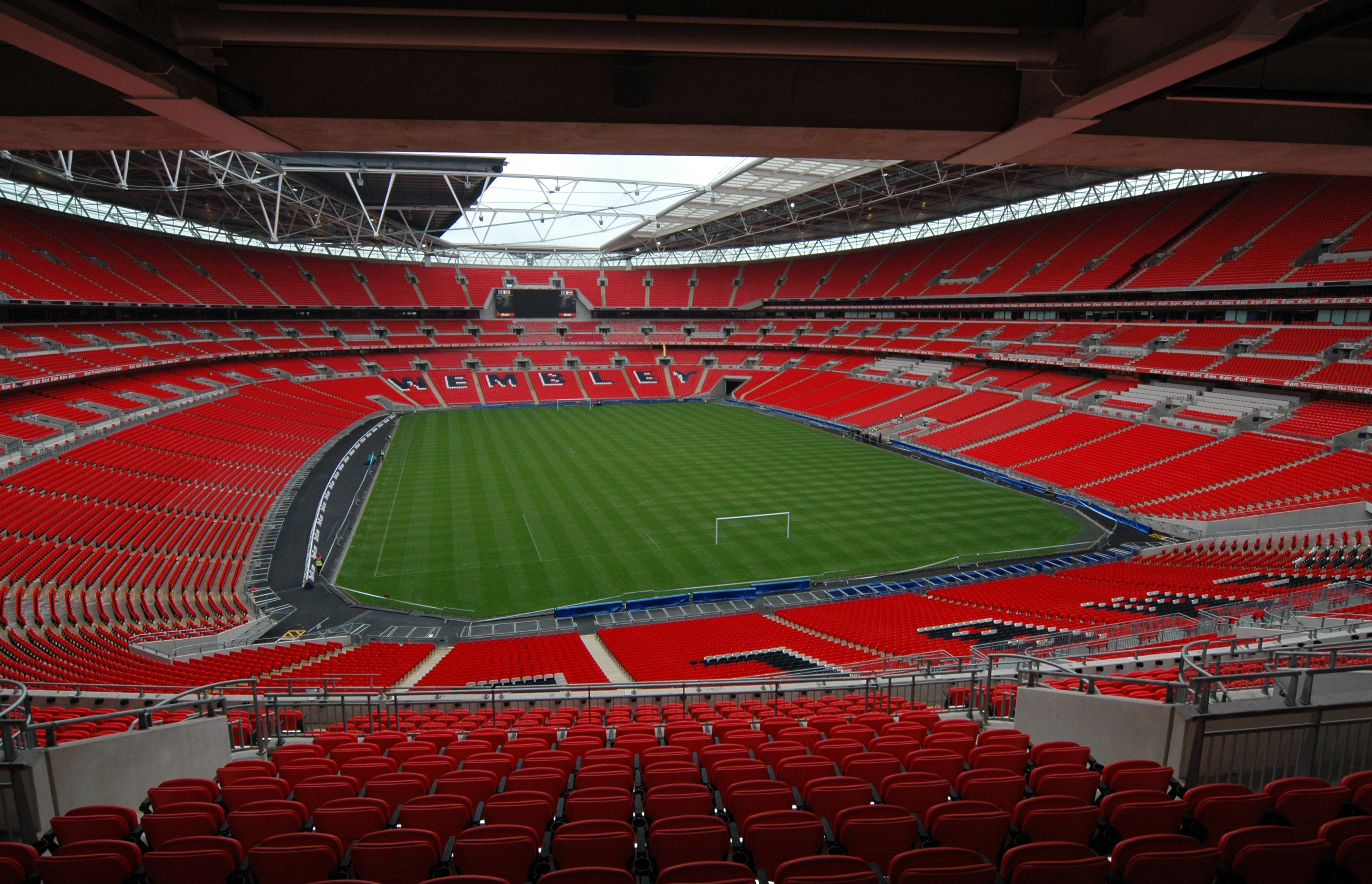
Wembley Stadium ready to show a football match.  Image from Wikipedia accessed 01/06/2015 


With all that said, there has always been the discussion of whether such a thing as a video game can be considered a sport.  There are of course many views that feel strongly one way or another, but for me I’d like to discuss this from an architectural point of view, using the stadium as a vector point.  I feel it has a way of showing how similar we are and how competitive gaming as a large-scale event visually correlates with a conventional sport event. 

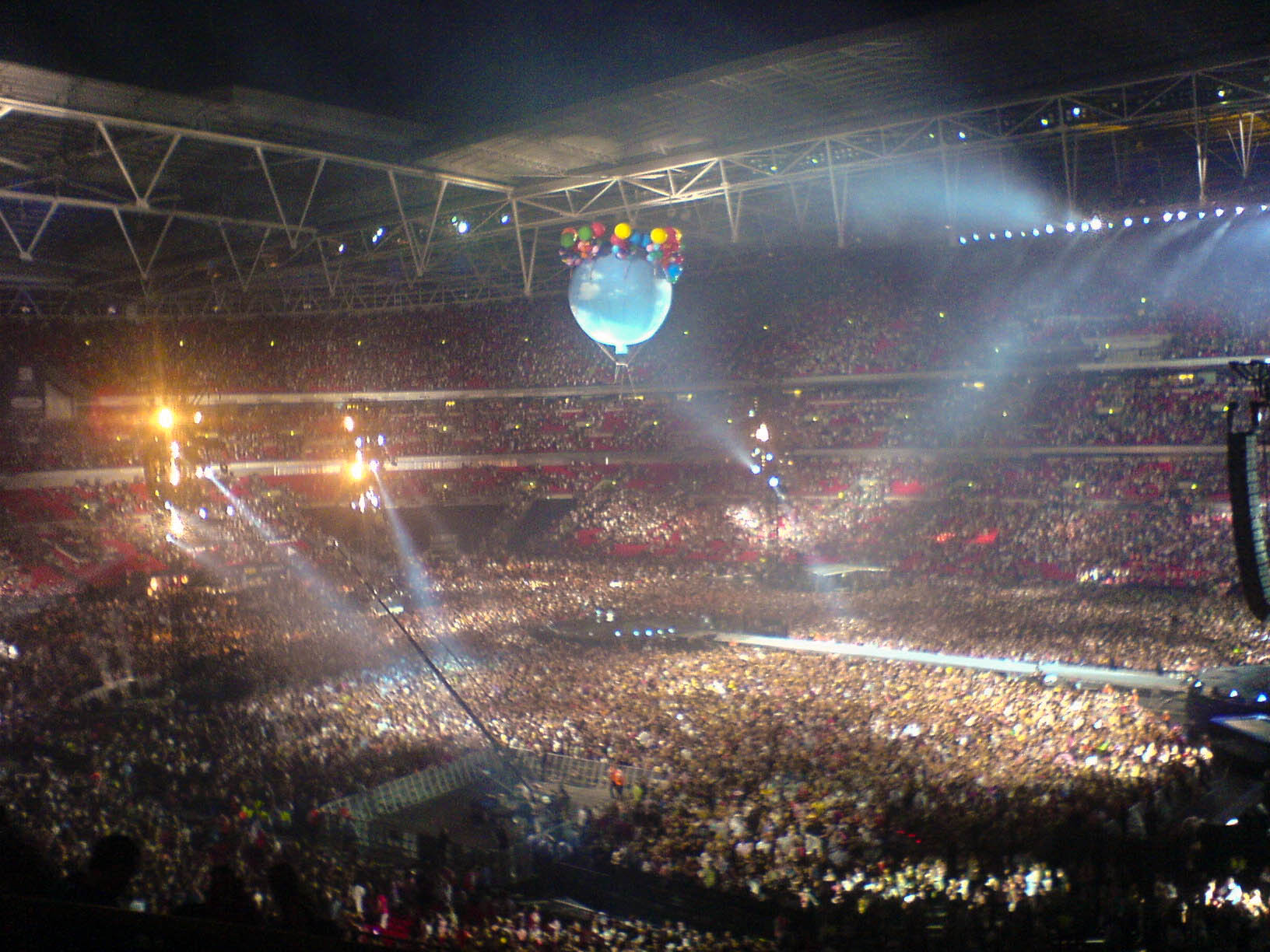
Wembley changes from a football ground to a concert event.  Image from Wikipedia access 01/06/2015


The stadium itself is quite simple in its own way; with its design focusing on giving a group of people a place to come together and experience an event together with relative ease and comfort.  Regardless of whether it’s a massive venue like Wembley or a local football ground with a couple of stands; it can accommodate different events by adapting itself to suit the needs presented.  To use Wembley as an example, it is used as a football pitch for big events such as the FA cup final, but it also has music concerts for bands like AC/DC or Foo Fighters.  Structurally, the stadium hasn’t changed beyond a temporary floor and stage in the space where a pitch would be, but beyond that everything is pretty much the same.  Visitors come with their tickets in hand; clothing and banners representing their support for a group through colours and logos; and cheer / scold on the action taken by those performing.  I have talked a lot in the past about how architecture is not the bricks and mortar but the experience that people feel in a place and by taking these experiences felt during a stadium event, one can see how ‘Esports’ also create architecture by giving people the ability to come together and have these mutual feelings akin to a football supporter seeing their favourite team play. 

The International #2 (2012).  Image from Wikipedia accessed on 01/06/2015


Going back to The International, for the past 3 years the finals have been held in Seattle to a host of thousands of people in person cheering for their teams.  During the Ti2-3 era, it was played at the Benaroya Hall, but recently it has been relocated to the Key Arena which in its time has hosted musical acts, basketball games and special interest events.  The International is a high quality event with match analysis, high profile commentators and multi-pov streams alongside a user-based compendium that gives people a program-like digital book to place their predictions and receive rewards while increasing the overall prize pool.  The arena itself features a large audience who dress in their teams’ colour; hold banners showing their favourite player / team / anecdote while pennants relating to the teams sit high up in the space which are lit-up according to their progress through the tournament.  The commentators sit to the side with their thoughts broadcasted over the PA system, while a large projection gives viewers the ability to either focus on the whole picture or a particular players pov.  The audience gasps and applauds as a play is made or a hero is picked much like a goal or skilled cross in football or the start of a song for a band.  The stadium remains the same, but with some minor changes it gives all these people the ability to experience these emotions which in turn, what makes a building architecture in my view. 

The International 4 showcases the difference 2 years makes.  Image from Reddit accessed 01/06/2015


I haven’t been able to attend any of these types of events yet, but I am very much looking forward to being able to in the future.  It doesn’t really matter if you believe that video games are/not a sport, but the stadium gives us the ability to enjoy our competitive activity and the potential for a roller-coaster of emotions that come with it. 

Update on Dota 2: 1-1 but it’s looking like NA’VI are going to take game 3.  If they take this it looks like it could be 3-1 final score but we shall see.

Tuesday, 26 May 2015

Thoughts on Rebuilding Lion’s Arch, Guild Wars 2

So I’ve been playing Guild Wars 2 over the past couple weeks to the point where I’ve got into the mentality of pre-expansion clear-up.  This generally means finishing up on little things you want to clear (gear, certain achievements, living story) before you’re hit with a large amount of content.  Because of this, I haven’t really been that engaged with Tyria recently, but a recent change to the city of Lion’s Arch perked my interest enough to talk about it. 

The lighthouse has seen its fair share of damage over the past couple years.  Screenshot taken 23/5/2015


Lion’s Arch has seen its fair share of damage over the 2-3 years of playtime with its most significant attack coming at the end of season one of the Living World.  It’s been left somewhat scattered and broken for over a year now and there has been a decent discussion about whether it should be rebuilt; with some believing it would undermine the factor of destruction and the toll it took on those who chose to defend the city.  Regardless, there has been some stirrings in Lion’s Arch recently and the Consortium (a corporation involved in Southsun Cove and the Fractals of the Mist) have footed the bill to rebuild the city and reignite some prestige into it.  It’s an interesting story with the potential for it to backfire but for now I want to look at what they’re doing from an architectural point of view. 

Construction slowly starts above the WvW portals.  Screenshot taken 23/5/2015


On the surface, one could say that there isn’t a great deal to look at when it comes to the current level of construction.  There are a great deal of scaffolding up with a wooden frame against a metal mesh and masonry that are focused in at 2-3 sites around the city.  These sites are quite tall, using airships to move in large curved formations giving the impression of a large rounded tower to be built overlooking the current Asuran portal gates to the major cities of each race.  Reading the blog post, one sees why these structures are being put into place as follows:

“The plan of the city leaders is not to attempt to fully restore the landmark as it once was, but rather to implement an enhanced design that will more realistically serve the Tyria of today. In light of the lessons learned from the Scarlet Briar and her massive airship drill, the Breachmaker, the city will be a more fortified city, with a design intended to protect citizen and visitor alike.”

The airship brings in a large piece of wall for the construction of a tower-like building.  Screenshot taken 23/5/2015


A tower of such height of course gives the city the ability to see threats from afar and the structures being curved diminish the potential weak spots of a square or flat frontage building.  That being said, having tall, imposing structures give the potential for them to impose onto the city itself disrupting the original feel of Lion’s Arch in Guild Wars 2 being this pirate run city and not a capital with a standing army.  The events of the Living Story may have changed this, but I still think it’s important to make sure these potential structures don’t stand out beyond the rest (A bit like Brutalism and how some structures are considered concrete monstrosities). 

Artist impression of what the new Lion's Arch could look like.  From https://www.guildwars2.com/en/news/lions-arch-construction-nears-completion-new-player-poll-announced/ accessed 23/5/2015


Looking at the blog, they did show a couple impressions of what could be going on in Lion’s Arch but I don’t really feel connected with them for a couple reasons.  First of all, I’m not too sure where this picture would fit into Lion’s Arch at the moment.  I think I would need a couple perspective / axonometric shots to truly come to terms with what they’re looking to do.  Second of all, I don’t feel a sense of centralisation which is a bit harder to pin-point when it could it said that Lion’s wasn’t centralised in the past.  What I’m looking for with this rebuild is a means of people to connect through either a route or an action; like the forge square previously where people would pass through to access their bank, TP or crafting professions while also being a route for people to go beyond the city into the world.  Because of the setting, aesthetics and previous interactions with other organisations in the world of Tyria, I do feel there’s a way to do this well through the creation of a bazaar or market-like square akin to the Mediterranean / North African settlements that trade from its docks to its markets. 

Souk of Marrakech.  Image from http://www.tripadvisor.co.uk/ accessed 25/5/2015


Places like the Souk in Marrakech are a melting point of culture, art, food trade and social interactions that creates its own mini-settlement for all to enjoy.  The basis of the land may be calm, but the stalls are awash with colour across the spectrum to delight the eye and inspire the mind.  The act of trading is not just a matter of transaction, but a social event through introductions, haggling and the purchase which sums up the level of interactions one experiences in such a place.  This is what I would love to see come into the more pedestrian areas of Lion’s Arch; creating an environment that gets people to interact with from a sociable point of view as well as movement.  The city is kinda half way there when it comes to the current mystic forge spot, but I feel that if Lion’s Arch is going to have a remake I’d love to see an injection of mercantile chaos into this fray.  Whether players would warm to such an idea is of course something that is unknown before implementation, but much like my previous post on player housing, we can create architecture through more than just bricks and mortar. 

The pirate council of Lion’s arch have given the city a great sense of character to me coming to Guild Wars 2 as someone not involved with the series previously.  Its reconstruction led by the consortium showcases a great deal of potential for the city; I just hope that the character from its pirate / mercantile backgrounds shines through against the fortifications in progress. 


Time of course will tell.

Monday, 18 May 2015

Returning to Path of Exile: Hardcore League, Knowledge and Architecture

So my last couple weeks have been a bit all over the place….

I originally planned to continue my Building in Starbound mini-series but I’ve come up against a couple things that I feel are important.  First of all, I don’t have that many resources available to me, especially with the recent update I’ve had to get back to my Homebase to work from my foundations.  It’s been a bit all over the place so I felt that I couldn’t really do something to the quality I was looking for with it.  I did look into using my older Terraria save, but there are a couple functions that I much prefer in Starbound such as augmenting existing blocks into something else e.g. glass block with frame for a window. 

There has also been the factor of some things I’ve found quite interesting recently and of course it’s much easier to write about something you’re enjoying rather than half-arsing it.  I do want to return to it in the future but I think I should spend some time re-educating myself about the practice of drawing building features before trying to replicate it in a virtual world.  In the mean-time, I have topics outline for the next couple weeks so should get back on schedule quickly. 

Without further to do, let’s talk about Path of Exile….

My first character from PoE.  Rather under-powered in comparison to my current play-through.  Screenshot taken 17/5/2015


I originally played PoE early 2013 coming off of playing Torchlight and getting a lot of enjoyment out of it.  ARPG’s had never been a genre I had played in the past, but by this point it was becoming a genre I could see myself playing for years to come.  I played a Templar which is a character that can naturally fit between the physical strength and magical caster to which I took a tanky ‘sword and board’ approach with elemental melee attacks.  I got a lot of enjoyment out of it, but it lost my interest in the later levels as it started to take a decent amount of time to clear mobs and I kinda wasn’t as tanky as I once thought.  Since then, I have become more aware of the game’s mechanics and with the announcement of the expansion the game has perked my interest once again.  This time however, I wanted to take a different approach. 

My current Templar with much higher dps while still keeping similar hp.  Screenshot taken 17/5/2015


I watched videos on the game from YouTubers such as ZiggyD, trawled the wiki and used the PoEBuilder to see how one can tailor a character and after playing through a couple new characters in ‘softcore’ I decided to go for it and make a character in the ongoing (or previous depending when you read this) Hardcore 1 month league.  I made a Templar again, but this time I looked to use projectile magic with buffs and totem summon with a nice mixture of stats for both defence and offense.  I was aware of the resistance reduction during the difficulties so planned accordingly, focused strongly on a core set of skills rather than lots of different ones and built regeneration to make sure that I wouldn’t be held back too often in terms of efficiency.  At the time of writing this, I’m half way into act 2 on Cruel difficulty and although I’ve had a couple close calls (~5% hp or less) I’m still holding on.  To the well versed PoE player, this isn’t anything special, but for me this means a lot as it took something to want to play in a mode where everything’s on the line.  Being cautious in the hardcore league has made my take on certain situations a bit slower, but as a by-product of this I have been able to take in the surroundings and see how much is going on as you traverse the landscape.  One such place was the Lunaris Temple with particular mention of level 3. 

Gold detail, smooth decor and sewers of blood throughout the lower Lunaris Temple.  Screenshot taken 17/5/2015


Lunaris is a place of contrast at heart within the bleakness of Wraeclast.  With grand walkways and golden motifs wrapped in quality cloths accenting the bold colours it gives the impression of a once powerful empire holding residence.  As you descend thou, you see Piety’s work (the boss of this location) created from a swarm of bodies and the blood runs dark red throughout its sewer system that perfectly back-up the array of miscreated beings that look to attack you as you progress through the area.  The gold and cloth are still there, it’s just being saturated by the blood creating a contrast that makes a piece of architecture seem so bleak and disgraceful have its own beauty.  This contrast is a narrative of architecture that has taken the building materials, the cladding and the décor and made something new of it.  Darkness, grit and grey can seem boring in many games but in the right hands (like with architecture) so much can still be done with its aesthetic.

Finer things in life within the Lunaris Temple.  Screenshot taken 17/5/2015


Being someone who finds Brutalism a fascinating time of architectural design, I very much hold this opinion that this bleakness can inspire and morph into something special.  Brutalism is often regarded as concrete monstrosities due to their concrete construction and greyish look, but through human interaction it has its own appeal.  Places like the Barbican Centre in London encapsulate this by being grey and concrete while adding different levels of high-rise, gardens, water and larger form walkways than your average tower block. 

Barbican Centre, London.  Photograph taken 14/02/2010


That being said, I wanted to find a piece of real-world architecture that encapsulates the Lunaris level 3 map and I feel that this does it…

A bone chandelier at the Sedlec Ossuary.  Image from Wikipedia 18/5/2015


The Sedlec Ossuary in the Czech Republic is a piece of architecture that makes bleakness and morbidity beautiful as it creates art through its bone collection.  Its chandelier, candelabra’s fixtures and various other items are all made from bones of the dead to around 40,000 remains (if Wikipedia is to be believed, unfortunately I’m not sure on the number myself I thought it was closer to 20,000).  On the surface, this place may seem outrageous or morbid, but its architecture has gone beyond its walls and created a narrative from it, much like Lunaris.  It’s in the nature of the ARPG to focus on the mob pulls and skill affects, but if you find yourself running through PoE anytime soon, take a second to look at the environment and think about what it portrays about what you’re doing and where you may be going.  I hope you found this interesting and good luck to those who choose to take the jump into a hardcore mode for the first time.

Let’s hope my Templar stays alive up to the end of Cruel at least.  -60% resistances is gonna be a bit of a bastard to deal with….