Showing posts with label form vs function. Show all posts

Monday, 6 July 2015

Arenas, Museums and Space

The length of my commute over the past few weeks have been a process of theory vs. reality.  The theory being I can get work done to and from work but the reality is having to catch connecting services and not being able to sit during peak time.  Because of this, I have thought up a new process that involves reading on the Sunday; mulling it over during Monday and putting it to paper (physical or electronic) that evening.  Hopefully this will produce content that’s on time and interesting but of course time will tell.  Anyway, I recently found myself going over some old essays and I would like to talk about one of them today.

Although I do talk a lot about ‘space’ when it comes to architectural theory, I feel it’s a nice branching topic of discussion that has a varied number of applications.  One such way is Bataille’s piece on architecture (excerpt from my old copy of Rethinking Architecture) which corresponds with this concept in an interesting way.  He talks of architecture being an expression of society through the view of official characters such as palaces and cathedrals as they impose and create a social environment that reflects their grandeur.  His comment on the duality of man and architecture reflects this saying:
…if you attack architecture, whose monumental productions are now the true masters across the land, gathering the servile multitudes in their shadow, enforcing admiration and astonishment, order and constraint, you are in some way attacking man.

The Atrium at the Tate Modern has always been a rather bear-bones environment, but it has seen host to a great number of cultural installations.  Image from http://www.wikipedia.org/ accessed 06/07/2015


His later piece on the ‘museum’ has a similar connotation in that museums are an embodiment of societies desire to contemplate and observe in which visitors are exposed to what we can be throughout the ages.  The museum presented as a ‘container’ to the ‘content’ that the visitor interacts with keeps it as a piece of architecture reflect a particular social environment (knowledge and culture predominately) as the people flow through the exhibits to reach a point where they feel more informed, culturally rounded or (as Bataille puts it) ‘visibly animated’.  To me, this correlates strongly with my previous discussions on ‘space’ and ‘place’ as the museum and its exhibits live within these two phrases; as the museum hosts the collection while the content flourishes within a relevant place before the content is refreshed.  Whether the museum is in a historic grade one listed building overlooking a grand estate or a refurbished factory, the collection (its content) is what makes a museum, a museum.  We have places like the Tower of London but we also have the Tate and together they are able to attract large numbers of visitors who are looking for a cultural experience while they visit.  It is with this thought that games in some situations follow this theory through the concept of the ‘arena’. 

Chest-high walls among a set-piece that is design for conflict.  Image from http://wikigameguides.com/ accessed 06/07/2015


In a large number of action titles, you will be moving along a path and come across a space specifically design for a set piece to happen in.  An example of this can be Gears of War, where the abundance of chest-high walls will usually signify the approach of an incoming battle.  The player moves into this space aware of what they are looking to experience, readying their senses and acting accordingly.  They battle through this set-piece then find themselves moving along another path into the next conflict which will most likely follow the same pattern, regardless of size or prestige shifts between them.  Other examples such as a large open space with weapons littered around to signify an incoming boss battle or the more direct transitions in a game like Painkiller which feature an ongoing series of checkpoints can differ massively architecturally, but still give a similar impression to the player.  It shows that the environment can be a grand vista of physics and high-end graphical effects or simply rendered street but as long as the content aligns with the player’s desire for an experience in a well versed way it can be a great thing.  Referring back to Painkiller, some the environments may look quite simple, but its deliverance of content puts it low on the player’s priority of thoughts. 
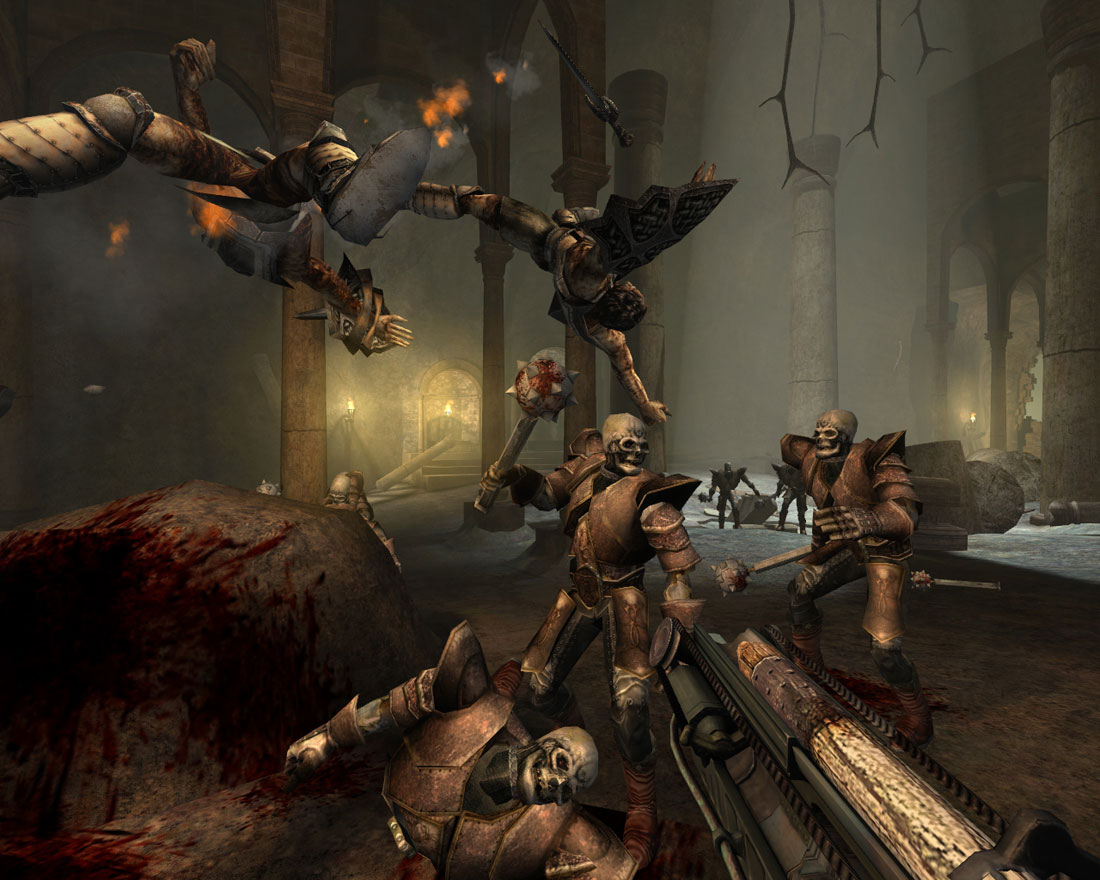
Painkiller primarily is a series of arenas, but focuses heavily on combat to create an experience the player is looking for.  Image from http://www.nvidia.co.uk/ accessed 06/07/2015


To conclude, architecture can be a grand monument as much as a hovel but creation of an experience is what makes it truly shine.  Games do this brilliantly and it shows that chest-high wall galleries can be fun if the experience is attuned alongside it.  A game where the world around me is exploding into a million little events like Bulletstorm or Wolfenstein: the New Order can give me the same feeling of an experience as a puzzle in Antechamber due to their means of presenting the game-play to the player.  


References:
*Bataille G Archtiecture as shown in Leach, N. Rethinking Architecture(2008).  Routledge, London p.p. 20-23

Tuesday, 26 May 2015

Thoughts on Rebuilding Lion’s Arch, Guild Wars 2

So I’ve been playing Guild Wars 2 over the past couple weeks to the point where I’ve got into the mentality of pre-expansion clear-up.  This generally means finishing up on little things you want to clear (gear, certain achievements, living story) before you’re hit with a large amount of content.  Because of this, I haven’t really been that engaged with Tyria recently, but a recent change to the city of Lion’s Arch perked my interest enough to talk about it. 

The lighthouse has seen its fair share of damage over the past couple years.  Screenshot taken 23/5/2015


Lion’s Arch has seen its fair share of damage over the 2-3 years of playtime with its most significant attack coming at the end of season one of the Living World.  It’s been left somewhat scattered and broken for over a year now and there has been a decent discussion about whether it should be rebuilt; with some believing it would undermine the factor of destruction and the toll it took on those who chose to defend the city.  Regardless, there has been some stirrings in Lion’s Arch recently and the Consortium (a corporation involved in Southsun Cove and the Fractals of the Mist) have footed the bill to rebuild the city and reignite some prestige into it.  It’s an interesting story with the potential for it to backfire but for now I want to look at what they’re doing from an architectural point of view. 

Construction slowly starts above the WvW portals.  Screenshot taken 23/5/2015


On the surface, one could say that there isn’t a great deal to look at when it comes to the current level of construction.  There are a great deal of scaffolding up with a wooden frame against a metal mesh and masonry that are focused in at 2-3 sites around the city.  These sites are quite tall, using airships to move in large curved formations giving the impression of a large rounded tower to be built overlooking the current Asuran portal gates to the major cities of each race.  Reading the blog post, one sees why these structures are being put into place as follows:

“The plan of the city leaders is not to attempt to fully restore the landmark as it once was, but rather to implement an enhanced design that will more realistically serve the Tyria of today. In light of the lessons learned from the Scarlet Briar and her massive airship drill, the Breachmaker, the city will be a more fortified city, with a design intended to protect citizen and visitor alike.”

The airship brings in a large piece of wall for the construction of a tower-like building.  Screenshot taken 23/5/2015


A tower of such height of course gives the city the ability to see threats from afar and the structures being curved diminish the potential weak spots of a square or flat frontage building.  That being said, having tall, imposing structures give the potential for them to impose onto the city itself disrupting the original feel of Lion’s Arch in Guild Wars 2 being this pirate run city and not a capital with a standing army.  The events of the Living Story may have changed this, but I still think it’s important to make sure these potential structures don’t stand out beyond the rest (A bit like Brutalism and how some structures are considered concrete monstrosities). 

Artist impression of what the new Lion's Arch could look like.  From https://www.guildwars2.com/en/news/lions-arch-construction-nears-completion-new-player-poll-announced/ accessed 23/5/2015


Looking at the blog, they did show a couple impressions of what could be going on in Lion’s Arch but I don’t really feel connected with them for a couple reasons.  First of all, I’m not too sure where this picture would fit into Lion’s Arch at the moment.  I think I would need a couple perspective / axonometric shots to truly come to terms with what they’re looking to do.  Second of all, I don’t feel a sense of centralisation which is a bit harder to pin-point when it could it said that Lion’s wasn’t centralised in the past.  What I’m looking for with this rebuild is a means of people to connect through either a route or an action; like the forge square previously where people would pass through to access their bank, TP or crafting professions while also being a route for people to go beyond the city into the world.  Because of the setting, aesthetics and previous interactions with other organisations in the world of Tyria, I do feel there’s a way to do this well through the creation of a bazaar or market-like square akin to the Mediterranean / North African settlements that trade from its docks to its markets. 

Souk of Marrakech.  Image from http://www.tripadvisor.co.uk/ accessed 25/5/2015


Places like the Souk in Marrakech are a melting point of culture, art, food trade and social interactions that creates its own mini-settlement for all to enjoy.  The basis of the land may be calm, but the stalls are awash with colour across the spectrum to delight the eye and inspire the mind.  The act of trading is not just a matter of transaction, but a social event through introductions, haggling and the purchase which sums up the level of interactions one experiences in such a place.  This is what I would love to see come into the more pedestrian areas of Lion’s Arch; creating an environment that gets people to interact with from a sociable point of view as well as movement.  The city is kinda half way there when it comes to the current mystic forge spot, but I feel that if Lion’s Arch is going to have a remake I’d love to see an injection of mercantile chaos into this fray.  Whether players would warm to such an idea is of course something that is unknown before implementation, but much like my previous post on player housing, we can create architecture through more than just bricks and mortar. 

The pirate council of Lion’s arch have given the city a great sense of character to me coming to Guild Wars 2 as someone not involved with the series previously.  Its reconstruction led by the consortium showcases a great deal of potential for the city; I just hope that the character from its pirate / mercantile backgrounds shines through against the fortifications in progress. 


Time of course will tell.

Monday, 13 April 2015

Revisiting Starbound: Thoughts on 2D Architecture Amongst Other Things

This weekend has been a rather busy mixture of things to the point where I didn’t really know what I wanted to write about.  I’ve been helping out for the upcoming general elections, producing a documentary with my history society and watching the Dota 2 MLG Lan finals all while fitting in time to play some games.  With the start of season 5 (or series 5 the words have become interchangeable these days) of Game of Thrones I thought I would be all for putting stuff down to watch it, but I haven’t even found time to do so.  Because of this, you may imagine something like this hasn’t seen much of the light of day over the past couple days. 

So, as I sat back in my chair watching EG vs. NiP battle it out a random thought dropped into my head regarding my recent return to Starbound, a game that I enjoy that features those building elements purposely built for discussions on architecture.  That being said, I wanted to try and find a way to show what makes it great for me against its predecessors. 

Starbound is a 2-dimension procedurally generated sandbox game that features a strong focus on materials and crafting to produce a vast quantity of weapons, armour and building components amongst other things.  It has a great deal in common with Terraria (also being 2D) but where Starbound differs is through such factors as interacting with multiple worlds, object redistribution and character augmentation that look to present a more RPG-esc mechanic against Terraria and other sandbox crafting games like the highly popular Minecraft.  Having an interest in construction and design, you would imagine I would prefer Minecraft a great deal over Starbound due to the 3 dimensions and tools to create vast builds, but it’s just never got to that point for me.  My time in Minecraft was enjoyable and I liked discussing the concepts of using technology to create alternative means of architecture (see my post on player housing) but as a game I didn’t feel engaged.  So again, what makes Starbound great for me?


Player Ship designed to look like a train.  Screenshot Taken 13/4/2015


From a gameplay point of view, it’s very clear that Starbound (in correlation to base game models) offers a nice mix of character progression and combat beyond the ‘wave stick at skeleton’ that Minecraft survival mode offers.  From an architectural point of view however, I feel that it creates a ‘less is more’ vibe that allows the player to add detail in a different way thanks to the 2D presentation.  You can show interiors and exteriors working together against the backdrop of a verdant valley or night’s sky which can dwarf its surroundings or slip into the environment.  These are all factors of architecture and why in design in particular fashions; as we strive to keep one village as incognito as it first settle some 500 years ago vs. a contrasting villa of modernism shooting out against a forest unchanged for centuries. 

An earlier play-through of mine featuring a more slap-dash approach to the spaceship.  Screenshot taken 12/10/2014


With all this taken into consideration, I looked at my homebase in Starbound couple days ago and it very much sits in the ‘basic / utilitarian’ side of design as its rectangle wooden frame features my crafting stations, storage and bed to present some resemblance of a home.  Since then, I added another floor and some minor artistic flourishes in the shape of a painting, chandelier and suit of armour found on a remote planet, but it’s still rather basic and not being too interesting.  I took a moment to think about what I was doing and came up with an idea that seem only obvious after conceptualising it, Sections. 

The simple dwelling soon to be improved on.  Screenshot Taken 13/4/2014


When design a building, there are a number of drawings you’ll look to do to conceptualise the design for the client.  Plans, perspectives, elevations and axonometric are all used alongside the section which takes a vertical cut through the building to show a number of different things.  A section shows wall structure, windows, stairwells, voids and rooms all alike focusing on particular details like how the exterior wall interacts with a roof.  When I studied architecture, these drawings took a decent amount of time for me but I thoroughly enjoyed drawing timber frame buildings with the joists at a regular pattern or masonry walls with cavity wall insulation and render with the ever so often façade of timber slats or similar aesthetical choice (I can’t remember if those materials go well together but for the purpose of this you kinda get what I mean).  Taking all this into consideration, I built up my walls and started to add all these little features which is slowly taking my simple lived-in house into something special which I’m slowly working on when I have time available.  Much like groups of people who come together in Minecraft to recreate a city, this has got me thinking about rebuilding pieces in Starbound such as ‘A Walking City’ from Archigram but of course on a much smaller scale. 


So to summarise, building in 2D has been an interesting experience that is allowing me to rekindle some of that love for drawing sections in architecture I felt previously.  Thinking about it, this probably goes back into my interest of wanting to know how things work and all that engineering stuff.  These couple weeks have been fascinating for me looking back at where this has all come from.  Hopefully next week I’ll be able to show some screenshots of progress in design and talk a bit more about it.  

Monday, 30 March 2015

My Modern Gaming Architecture: The Black Citadel

During last week’s retrospective on my influences from gaming as a child, I made reference to a piece of design that encapsulates my interests in the industrial aesthetic and engineered feel in the Form of the Black Citadel.  Today I want to try and describe what I think makes this special to me but first, a little context to its existence…

The Black Citadel is the main city for a bestial race called the Charr within the Guild Wars series.  The site in question originally played host to a large Human nation called Ascalon, which protected itself against the Charr through the construction of a large wall amongst other things.  It was an ongoing battle, but the Charr used a great power to cause great amounts of devastation to the land which became known as the Searing.  Over time, the Charr moved into the lands and construction of the Black Citadel started over the ruined remains of Rin, becoming the main post for the Iron Legion (one of 4 recognised Legion with the others being Ash, Blood and the opposing Fire).  In Guild Wars 2, players get to visit the Black Citadel as one of 5 racial cities and one neutral city where all are available to explore its contents. 

To come at the Citadel from a broad point, it’s mass of being this vast piece of connected metal and ongoing mechanical sound perfectly encapsulates the Iron Legion’s ethos of engineering, weaponry and pragmatic thinking while having a certain sense of beauty in the finer details.  It is my belief that pure function construction finds ways to create art through it just working; a little bit like Victorian age railway archways or similarly-aged greenhouses showcasing an aspiration to let people know it can be done.  You could imagine the Charr being proud of this structure, but due to their nature it may be to it being a continual reminder of victory over a previous enemy. 

Here are some words on specific parts of the Citadel that I find great. 

The Core
The Black Citadel and its main core looking from the Lion's Arch Portal.  Screenshot taken 30/03/2015


 As I looked to get setup to take these screenshots, I had to take my character from Lion’s Arch (the neutral city) to the Citadel via a portal.  This meant that my entrance to the Citadel was not via the conventional front gates that sit lower down on the ground but a higher side-entrance that roughly sits in the middle in terms of height.  Regardless of view, it presents you with a massive core that combines many sheets of metal to create a sphere that dominates the landscape.  Its exterior which creates this look is a suspended form that comes from a mass of supports that are dimly illuminated by the afternoon sunlight and torch-poles, giving it an almost golden look in the reflection.  This very much reminds me of visit the Eiffel Tower in Paris during my first year university trip, where during the late evening I stood underneath the tower looking up through the structure.  Due to lighting, the tower appeared orange in colour giving it an odd glow that I thought was brilliant. 

The exposed structure that keeps the shell of the core in place.  Screenshot taken 30/03/2015

 Going back to the core itself, the look of it makes me think of two particular things.  Firstly (and more relevant to my thoughts) it makes me think of and jet engine or similar rotary device that has been put into an explode view while it’s been stopped in time.  The Citadel features quite a few fans, propellers and doors that rotate in a similar fashion so it all fits into the aesthetic of an industrial feel.  The other image I get from this structure is that of astronomy as the orange pod-like blips in this context could represent planets revolving around a central being like a sun.  Although I do see this, I personally don’t feel much connection with the general aesthetic. 

Beneath the Eiffel Tower at night presents a similar feeling to the framework in the Black Citadel.  Photo taken 02/2009


The Bane / Ruins
The ruins being overlooked by the ever present Charr stronghold.  Screenshot taken 30/03/2015


To the rear of the Citadel the player is able to interact with areas that look to transition the space between the older Human ruins and ever-present Charr settlement.  The more obvious place for this are the ruins of Rin that around the west / south-west reaches of the Black Citadel on the much lower ground level.  A player interacting with this space will most likely come for the couple vistas and Points-of-Interest for map completion, but in their haste they may end up missing the vast contrast that the ruins sit in.  The small collection of upright sections of tower and crumbling walls are all but overwhelmed by the ever-present core and smog that looks to surround it like some kind of aura.  This example encapsulates the contrast between the ‘old’ and ‘new’, but where I feel it’s done even better is with the gladiatorial arena called the Bane. 

The Bane arena built without concern to the present ruins of their previous enemy.  Screenshot taken 30/03/2015
The Bane sits at the bottom of the main core of the Citadel in which fights between Charr (primarily Gladiums) are fought in an arena beneath an audience.  What makes this great is that the arena’s circle is interrupted by a ruined structure which was incorporated into the design rather than demolishing it.  It reinforces that feeling of victory as mentioned previous, but in this context could also refer a reminder of an ongoing battle with the Ascalonian ghost that continue to siege the land. 

The Forge

A melting pot of scrap and ingenuity that defines this place.  Screenshot taken 30/03/2015 


I wanted to end on this piece because the sheer scale of it continues to present the Citadel as this mass of industrial achievement.  The southern section of the Citadel is primarily a massive metal forge in which the player looks down from a high up viewing point and fly-over vista when activated.  This forge is not designed as much as formed together; with a vast amount of scrap metal littering the ground being instructed by a colossal metal crane that forms the material anew into the ever-increasing armour of the Citadel.  It’s an organised mess that keeps the cogs turning and machinery turning so that it remains the most prominent feature on the map to anyone who may gaze upon it. 


Last week I was able to see potentially how much my time with video games had influence my interests as an adult in terms of architecture.  Today, I wanted to see where my current gaming time fitted into this and whether my thoughts had changed in any specific way.  Naturally, I would say that I’m more aware of it these days and as such may be reading more into the subject than I would of normally.  That being said, I feel that what makes the Black Citadel a great piece of architecture in my eyes is that industrial, mechanical feel that features heavily in my younger days of gaming and its much lower textured brethren.  What I feel sets this piece part is the factor of context; with its ability to incorporate many years of lore so that its narrative comes alive amongst its aesthetics to create more than just a place in the Guild Wars 2 world.  As mentioned last week, a field is a field but the story creates architecture.  


*If you would like to know more about the Lore surrounding the history I briefly mentioned, please watch this Lore video by Wooden Potatoes: Guild Wars 2 Lore: The Fall of Ascalon

Monday, 23 March 2015

Video Game Architecture: my experiences from the past

A couple days ago, I was watching a couple twitch streamers when I took notice of what music was being played.  It was a collection of OCremix tracks featuring reinterpreted music from titles such as Sonic, Megaman and Jet-set Radio amongst other things which very quickly embedded classic melodies into my head for the remainder of the day.  While this was going on, it got me thinking about how much music, licensed or otherwise, I got into from the medium of video games which still holds a strong point of influence to this day.  Originally, I was going to talk about it this week, but as a means to keep the subject of architecture in context, I thought I would talk about a couple architectural pieces from games during my childhood / early teenage years that I particular find great.  There may be some crossover with level design, but the primary subject matter is that of architecture. 

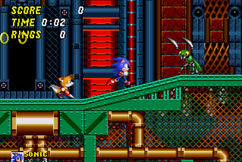
Sonic the Hedgehog 2: Metropolis Zone

Sonic and Tails come up against a foe in the Metropolis Zone.  Image from the Sonic wiki (http://sonic.wikia.com/)

For many people, the Casino Night levels aesthetic or Chemical Plants soundtrack will hold a special place in their heart.  But for me, from an architectural point of view the way Metropolis creates a feeling from its design of ‘overcoming the odds’ and ‘getting through the machine’ is perfect for its placement within Sonic 2.  As a child I never owned a Sega Megadrive, so playing Sonic 2 was always on a time limit having to leave the communal gaming space or a friend’s house.  Usually, I’d end up getting to Oil Ocean and getting stuck on Act 2, but every so often the moons would align and Metropolis Act 1 would appear to greet me. 
Its heavy industrial feeling and challenging enemies (for me at the time) was quite appropriate as it tried to ‘keep me down’ and slow my progress.  The series of ups and downs through pipes, screws and cogs diffused the idea of progress as I tried to figure out whether I was taking the right path.  A particular moment I can remember is at Act 2, where the play needs to make a series of drops at the right sections to continue moving forward a little bit like the later bowser castles of Super Mario Bros. 
Looking back at it now, there are a new set of little touches that I feel make it great.  The way in which the levels physical ground is green makes me think of oxidised copper that originally shone greatly against its backdrop.  The feeling of the level feels like the industrial machine keeping you from achieving a goal, which of course has seen a number of iterations in social history with the working class being kept moving along by the factories they work in.  I do mention this often but Metropolis the film (1927) has some similarities that go beyond the naming. 
Metropolis holds this place because of its way in which it defined overcoming a challenge in my early childhood, but nowadays makes me think of my interest in engineering.  In particular my view of ‘Function over Form’ and that defined engineering can create great pieces of architecture that hold a unique form in their own way. 


MediEvil 1: Entrance Hall / The Time Device (City of Madness)

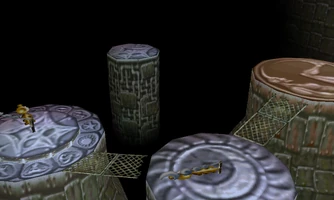
Clocks with a magical symbols bestow upon them.  Image From the MediEvil Wiki (http://gallowmere.wikia.com/)

The MediEvil series will always hold a special place for me as a game that made my time while having a Playstation One.  I never owned a Nintendo console (outside of the Gameboy colour) so where Zelda or Banjo Kazooee are fond memories of Nintendo 64 owners, MediEvil 1 and 2 occupies that spot.  Anyway, onto the levels…
Zarok’s domain features 3 levels at the climax of the game being ‘Entrance Hall’; Time Device’ and ‘Zaroks Lair’.  All three come under the umbrella title ‘City of Madness’ which one could draw a couple different conclusions from like the madness of the population enslaved by Zarok, his tiresome work to rule the land of Gallowmere or something in-between it all.  The ‘Entrance Hall’ has this rather typical magister / warlock tower feel to it with its spiral staircases and large library rooms, but the ‘Time Device’ contrasts this completely with industrial era mechanisms and multiple references to time.  The way in which runes (the game’s keys) are linked in with the clock-face near the beginning of the level is enjoyable to solve alongside the later time-based mechanics.  While doing this, the industrial vibe of the gears and railway system don’t feel out of place, but have their own ‘Nightmare Before Christmas’ aesthetic that the game is somewhat influenced by.  

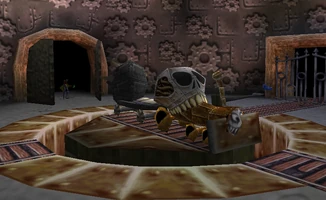
Zarok's railway system and personal train in the shape of a skull.  Image from the MediEvil wiki (http://gallowmere.wikia.com/)

For example, the train it’s a steam engine in the shape of a skull that clicks its bones as it moves along the track. 
Like with the Sonic example, the industrial feeling of the area has something special that has influenced my design preference of engineering, but where MediEvil differs is through its application.  The mythical setting gives a nice twist on the industrial feel which shows we can play with the visuals but still keep the concept of the function at hand. 


Crash Bandicoot 2: Sewer Tunnel levels (multiple versions)

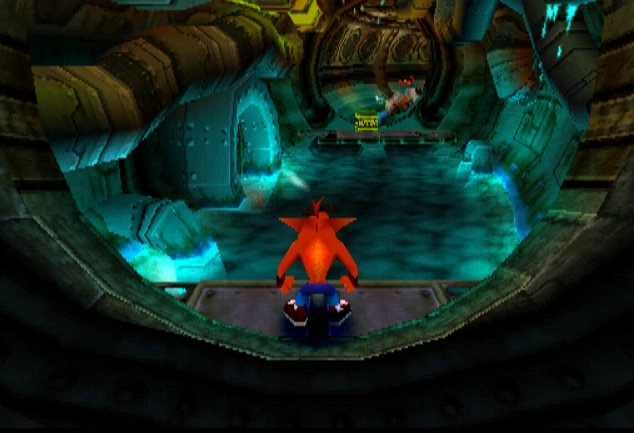
Crash being welcome into the sewers.  Image from Crash Bandicoot wiki (http://crashbandicoot.wikia.com/)

After the first warp room of Crash 2, you’ll find yourself a level that features a mixture of pipes, ducting, fans and wires that make up the sewer tile set.  The hollow sounds of Crash moving, the metallic soundtrack (as in the material not genre) and the aesthetics did much for these levels to remain my favourite in the game; bringing together a nice mix of challenge and pace that I didn’t feel in other tile sets.  One particular item I feel makes this possible are the circular doors that define each room, giving the player a mild sense of interest for what could be on the other side. 
As well as its industrial feel, the theme of it being a sewer opens the level up to some nice additions.  Much like MediEvil and its magical / mythical touches; Crash 2 adds water with electric eels shocking the ground intermittently, toxic waste in the style of rolling barrels and nitro boxes littered around to give that impression of a sewer system being hazardous.  The way in which I tried to avoid sewer water for being bad was as much the obstacle of electrified eels as was the fact that it was sewer water.  That being said, having an aversion to water maybe down to the infamous section of Chemical Plant Act2 in Sonic 2 which saw many people panic at the rise of the water level and subsequent frantic music. 


Timesplitters: Spaceport level (SP and MP)

Spaceways from a central atrium.  Image from Timesplitters wiki (http://timesplitters.wikia.com/)

Multiplayer shooters are nothing without its ability to create a diverse range of levels that accommodate a varied mixture of game modes and weapon types.  Keeping with my Playstation1 => 2 childhood, one such game that lived in my console at the time was Timesplitters; a fast-paced fps with a great cast of interesting characters, varied weapons and unique settings across a number of different eras and potential timelines.  To give an example of this, Cyberden and Spaceways both depict a futuristic setting but go for different interpretations of what that may incur.  Cyberden goes for a more industrial, dystopian feel while Spaceways goes for a cleaner, more technologically advanced aesthetic that one may consider utopian. 
If you’ve been reading through my influences, you may think why I went for the cleaner Spaceways over the industrial Cyberden?  I did consider this at first but on reflection it’s probably as simple as Cyberden feeling like not much was going on / a bit bland while Spaceways has a spectrum of colour injected into it.  Thinking about Spaceways a bit more, I feel that’s down to the concept of Futurism and our perception of what the future will look like with our ever expanded access to information and technology.  The way in designers construct these ideas of the future are a fascinating piece of our cultural history and for me, the way in which they use our modern times as a benchmark for the future brings out some nice results.  For this example, at the time I had recently gone on my first holiday outside of the UK to Gran Canarias (an isle of the west /north-west coast of Africa) and experienced air travel for the first time.  The process of the airport and its checks though its layout and aesthetics felt similar to the way in which Spaceways presented itself, be it with stronger contrasting colours.  I’m not one for sci-fi really, but the potential for what could be has always been a thing I enjoy. 


Reading through these examples, to which I could probably add quite a few more, you may notice a strong presence of industrial / mechanical aesthetics creating an environment to interact with.  Looking back at my foray through the world of architecture (in particular my interests in Brutalism, Futurism and Deconstructionism) it’s surprising to see how much of my interests have potentially come from the medium of video games.  Even nowadays when I look at the games I play places that have interesting uses of engineering stay with my memory the best.  The Black Citadel of the Charr in Guild Wars 2 is a mix of fire, metal and harsh mechanical workings that feels special amongst the more traditional settlements of the Human or Norn races to name such an example.  Having time to look back at this has surprised me as much as it’s made me smile and I know it’s going to be a similar feeling when it comes to my upcoming retrospectives.  I hope you found this interesting and possibly find the little pieces of your history that may have influenced you more than you know.  

*Images from relevant wiki sites of games relating to this post for non-profit use as a means to discuss the subject matter*

Wednesday, 25 February 2015

‘Starchitect’ Theory and Thoughts Towards Video Games

Over the past few days I’ve been considering what to write about for this week’s entry.  Recently I have found myself not being 100% what to write about or needing to know a lot more about a topic to give it a proper assessment (North African Kasbahs being one of them).  However, like those odd ideas that you have at 2am this one came across while thinking about something somewhat unrelated; the Guggenheim Museum by Frank Gehry in Bilbao, Spain. 

The Guggenheim is an iconic structure from 1997 that has been heralded as a moment for architecture, culture and society to coexist within the context of a super-modern aesthetic.  Its flowing structure is rather striking and personally makes me think of a modern, modernism (reinterpretation of 1920s Modernism) if one could be allowed to say such things.  Personally, I’ve not been too informed on the piece because as with my history, I’m pretty much a ‘bottom-up’ theorist and find a lot of my interest in things like housing projects and the sorts, but a term used to describe the Guggenheim did get me thinking. 
You see, I had originally looked at the Guggenheim recently due to a couple job postings for museum staff and I was interested what level of involvement they entailed.  As with all my job hunting, I look to do research into the site and its archives through a varied mixture of the official press and opinion pieces, but an interesting discussion appeared on the subject of ‘Stararchitects’ which naturally has some crossover with other forms of art.  For those of you not aware of the term, ‘Stararchitects’ describes pieces of Architecture (or Architects themselves) that get risen to the status of fame and celebratory note, where people can align themselves with a fan mentality.  During my studies of architecture, the general census from my fellow students was that of Corbusier and his greatness (which of course the guy is very influential), but aligning with my previous viewpoint I found interest in his housing concepts and how I could discuss it alongside theorists.  I can very much remember visiting Villa Savoye in France during my 1st year field trip and upon being asked what I felt about it I gave a response of respect, but of a reserved nature to which my tutor replied with, what I felt, was a combination of dislike and surprise.  Since then, I’ve kind of built a bit more respect for the piece but for me the human side through interaction has always grasped my interest which I hope to present here in some fashion. 

(Anyway, towards games)  If you take this concept you could probably attach it to any form of media, but I feel games have a unique way to show this through the combination of multiple factors which I hope to discuss here. 

Originally I felt there were three rough ways that games present high-regard in today’s world: the individual, the presenter and the genre.  The individual is what I would call the auteur designers or influential people making games for a particular studio.  To give a couple examples we can say David Cage or Roberta Williams.  These people attain significant recognition for the work they do for a specific area which they become known for.  For these examples, their genres of cinematic/narrative/action and point-and-click/80-90s adventure games define them where it may seem odd to discuss them outside of these genres.  Lastly, their companies of Quantic Dream and Sierra are known for these people and for these types of games and that’s what gives them high regard and status as a piece of the history of video game culture. 

In today’s world, there are examples that follow this and add to the extent that we can create both positive and negative connotations of the ‘Starchitect’ theory.  One of which is Ubisoft where the name has become ubiquitous with yearly open-world franchises that follow a ‘theme-park’ selection of mini-games and collectables to engage the player.  Another can be Bioware, with fantasy RPG’s with a strong narrative base, mature elements and recognised voice actors like Jennifer Hale.  On the complete opposite of this, Activision publish the Call of Duty series that has defined a multiplayer generation even beyond its FPS construction bring quasi-mmo progression into the larger public eye (of course, mmo-style progression was done before this in titles like battlefield 2 but CoD is the big one). 

When I look at other forms of media like film, I may see directors with specific genres or production companies with very specific stories, but I don’t necessarily feel that they all come together as often as in the earlier days of cinematography.  If I were to think of an example I would probably say Hammer Horror but if you are more versed in film media please feel free to comment as I would like to discuss this concept. 


To bring this to a conclusion, it’s in our nature to recognise trends in a number of fashions, but I believe that games have been able to find their own little way of showcasing this topic and continue to reinvent its meaning.  Recent years has seen the YouTube personality come into the fray as our method of consuming content has significantly changed with the advent of higher speed internet and I will be interested to see how the grow culturally along with the media of video games.  

Monday, 12 January 2015

Spectrum of Architecture and 'Man-Made Mountains' in Gaming

Architecture, like any visual medium, has the ability to invoke a wide range of emotional reactions from how it’s formed and the aesthetic direction that is used.  The traditional cottage can invoke feelings like nostalgia, warmth or community whereas modern flats may present more of a cold, functional vibe with individualism.  In a previous post, I mentioned a phrase called ‘The Nest and the Pillar of Fire’ and today I want to expand on that idea.

The phrase in question gives a rough spectrum of architecture in which we design our environment.  The ‘Nest’ describes the basic requirements of self; in that shelter gives us protection against the elements and others as well as being a representation of settlement.  Another way to describe it is using the term ‘function’ (in regards to form vs. function) where design is purely out of necessity for its inhabitants.  Examples of these can be such things as Neolithic huts, cairns, longhouses and other early civilization settlements where survival was the highest of priorities.  This is not to say that the concept of ‘Nest’ doesn't exist in today’s world just that these examples are generally given when describing the concept. 
The ‘Pillar’ is the complete opposite where its use is most likely itself; where the object may provide no substantial use for us other than aesthetics or prestige.  Also known as ‘High-Art’ or ‘Form’ (see above) these pieces of architecture can represent expressions of emotion, ritual, ideology and anyway in which the designer is tasked to create art in the built environment.  Monuments, obelisks and similar sculptured structures share this view, but it can be expanded into pieces like towers and skyscrapers like the recent ‘Shard of Light’ in London, England.  Looking at these examples of the ‘Pillar’ you may get the feeling of height being a defining characteristic that connects them.  Although it is true that not all objects that fit into the ‘Pillar’ demand sky-piercing attributes, it does bring us onto the idea of the ‘man-made mountain’ to which one may argue that the ‘Pillar’ originates from. 

The concept of the ‘man-made mountain’ generally comes from early civilizations and the rituals that come with them.  To keep the gods pleased (in which I mean polytheistic religion) temples were built and offerings made to keep the crops bountiful and danger at bay.  Temples generally wanted a sense of prestige about them, as it would show the gods that they were important to the worshipers, meaning that the way they were constructed had to reflect that; with lavish materials and size that could dwarf all other nearby structures.  As god could make great natural structures like mountains, valleys, etc their followers wanted to replicate that, hence the term ‘man-made mountain’.  Examples of this are places like Chichen Itza in Mexico, Borobudur in Java and the Pyramids of Giza, Egypt where ancient civilizations have made objects with specific geometry and vast manpower so that its prestige is unprecedented. 
In today’s world, we do continue to see this, but whereas these early examples are based in ritual, modern interpretations have a more human prestige or organisation achievement (arguably).  Skyscrapers that litter are larger cities of world are grand towers that look go higher than ever thought accomplished to show what we can do as a race (on a more general idea) or the presence of a particular organisation / business in its ability to produce such a structure.  These structures can bring on a number of different emotions like awe, fortitude, impression, suppression, etc but they still follow this original concept of the ‘man-made mountain’. 

If you've played games anywhere over the past 20 or so years, it’s easy to assume you've probably experienced this in some fashion.  Antagonists being at the end of some large settlement or structure like Mario, Castlevania or similar title are often used to show the strength that said character has and what the protagonist needs to overcome to accomplish their objective.  One title that I feel does this well is the Half Life 2 series (including episode 1+2) with the combine tower at the heart of city 17.  For a long period of the game, it features in one way or another to keep the player informed about a goal on the horizon and an ever present threat (in particular moving into episode 1 post-endgame half-life 2).  Somewhat similar to this concept, Dear Ester does this with a tower which has a flashing red light as a means to guide the player towards an ever present goal.  This idea can potentially be seen in how present particular mechanics, for example how a skill tree in an RPG works upwards as you gain levels to portray an advancement in power or survival game where players tend to start thinking about aesthetics once they get past the challenge of surviving in the designated environment (of which those of you who've played Minecraft will understand). 

Bringing all these concepts together one can naturally see the design concept of the ‘tower’ within Ubisoft which has kind of become a parody of itself.  For those of you unaware, Ubisoft’s titles of 2014 (Watch_Dogs, Far Cry 4, Assassin’s Creed: Unity and The Crew) all feature towers in some fashion designed to progress the game and unlock more content.  Although some of these titles do make sense in world, they do seem rather odd as a player for example, The Crew is a racing game where you don’t leave your vehicle but you go around unlocking radio towers.  I’m quite indifferent to the towers (probably because I don’t play many AAA titles and don’t experience this repeat as often) but looking back on these concept of the monument and ‘man-made mountains’ I feel its shifted a bit towards the ‘Nest’ or ‘Function’ ideology; as its presence can be describe as somewhat mundane being a means to continue play rather than holding a sense of accomplishment or prestige. 


The spectrum of architecture is a simple one, but it does allow us to consider a wide range of concepts and emotions in our built environment.  Game present this spectrum in a pretty cool way and I hope to see the idea explored further in future as we are currently doing with the idea of ‘what is a game?’.  As a player, consider how things like the progression of the characters, story, aesthetics or mechanics come along and see if you can find links into the concept of ‘man-made mountains’.  I hope you found this interesting and if you have any questions feel free to ask.  

Friday, 24 October 2014

Antichamber - Perspectives, Viewpoints and Voids

This week has brought up some unexpected events that have kept me rather busy.  Although I like to push for the beginning of the week publishing, I do take priority on IRL tasks.  I’m looking into organising a staggered topic next week (as in mid-week release) to make sure they aren't too closely published.  With that out of the way, onto a game I started playing again this week…

*This will feature minor spoilers regarding the progression of Antichamber from a mechanic PoV.  Avoid the subject on Block Manipulation if you’re looking to read with spoilers in mind.*

Antichamber by Alexander Bruce is a first person puzzle game which conveys a totally new way to consider mechanics via viewpoints and perspectives in my opinion.  Its ability to confuse and mind-bend is fantastic; taking concepts you would be accustomed to in traditional puzzlers and juxtaposing it within its ‘modernist’ aesthetics (Modernist as in architectural imo).  I originally picked up this title in early 2013 putting around 4 hours into the title making slow progress; to a certain point where my thoughts couldn't comprehend any direction of specific mechanic to act on.

To briefly define the types of mechanics, I would say there are two main forms it takes on; room viewpoints and block manipulation.  The rooms as a puzzle work in terms of how you enter / look/ move/ leave a space, creating a multitude of possibilities to the user.  For example, an early room features a ‘gallery’ space with cube exhibition pieces in a 3x3 manner with gaps between them.  As you look around the exhibitions, the objects change from faces; to abstract sculptures and paintings; to moving pieces and a hidden passage.  The great thing about this passage is that logically, it pushes you into the middle of the gallery space, but in truth it’s an entirely new space with a multi-coloured maze.
The second mechanic (blocks) comes into play when the player receives a block manipulator a short while into the game.  This originally has simple applications akin to something like portal (taking object from point A to B) with blue blocks; evolving into a mix of geometric creation and multiplication in the green phase; and extruding blocks into shapes / passageways with yellow.  There is one later stage (red) which I haven’t got it yet, however at the time of writing I am very close to attaining the power and may add an addendum to this piece.
By bringing together these two forms of mechanics, it allows the player to experience a new way of thinking and put focus on the finer details rather than the larger pictures (possibly macro vs. micro in some roundabout way).  One can naturally do this in architecture and many have when it comes to judging our spaces and the play of interaction between them.  This can be represented in a couple ways in architecture, in particularly perspectives and voids.

Perspective can be thought in both a theoretical and practical way, but naturally they come together to form a similar understanding.  On one hand we have the tools of architecture (Sections, Plans, Elevations, Isometric, and Axonometric) which give us clear understanding of what they intend to be e.g. a front elevation shows of the façade of a building.  The other hand presents the idea of feeling / emotion / general thoughts when we look at an object from a number of different viewpoints.  A couple examples of this would be the English country garden and its folly’s or the Holocaust memorial site in Berlin, Germany.  The latter example I feel has a particular corroboration with Antichamber; as the Spartan, blocky pathways present a number of different viewpoints and perspectives creating a number of different thoughts for the user.  With this being said, if I was to add to Antichamber, I would like to play with the idea of light as the memorial does to possibly add a new layer of mechanics.  Although perspective is at the forefront of this experience, the minor details granted through the play of voids makes it brilliant to study.

One may naturally see voids as ‘non-space’ that does not dictate design or consideration and to some extent they would be correct.  In our everyday lives, we interact with voids as a means to get from point A to B.  Such examples like underpasses, alleyways, corridors, etc typically fall into this category where the edges of ‘places’ intersect with each other.  However, we interact with these voids and as such create spaces from them, whether it is interactions with other people or the area around you.  Graffiti (although generally given a negative social impact) is a great example of the interactions of voids and places like London’s South Bank have benefitted greatly from the user of this art form.  Theorists like Michel Foucault discuss this matter as a means of ‘other spaces’ in which he states:

“We are in the age of the simultaneous, of juxtaposition, the near and the far, the side by side and the scattered.  A period in which, in my view, the world is putting itself to the test, not so much as a great way of life destined to grow in time but as a net that links points together and creates its own muddle.”

If we are to take a theory like this, one can see a connection to Antichamber with its rooms and connections between them.  On the surface the connections are a mix of stairwells, elevators and corridors; but on reflection expand into multi-layered sections where walking creates one outcome and jumping creates another.  Antichamber is of course a very abstract example, but it can be something to study in the architectural and gaming world to produce interesting ideas with areas which may not get a lot of attention.  To use an even more up-to-date example, P.T (Silent Hills Playable Teaser) I feel plays with the idea of voids and perspective to create its eerie horror that brings the player into a world of uncertainty and fear.

Like with many things in our subconscious we don’t give them a second thought, but the practice of non-space can be something to open a world of new design possibilities in both the real and digital world.  In your own journeys, take a moment to consider these places between buildings and think about what it means and how it interacts with its surroundings.  I hope you enjoyed this piece and please feel free to discuss theories / suggestions.

References
Antichamber – Alexander Bruce (2013)
Foucault, M. (1967) Of Other Space: Utopias and Heterotopias

Monday, 22 September 2014

Receiver and the Discussion of Combative Design Theory (form:function)

These past couple weeks have been rather busy with ‘IRL’ stuff so naturally things like this have been pushed to the side.  That being said, I enjoyed a little game over the weekend that I want to talk about in regards to a relatively modern architectural design choice. 

Receiver is a very small indie-fps title from Wolfire Games created as part of a 7 day fps game challenge which looks to create quasi-realistic gun mechanics.  Whereas in a conventional fps the reloading mechanics are a single button press; receiver includes individual bullets, magazine loading, checking the chamber and releasing the hammer to name a few.  It’s a rather confusing experience when you initially load in, but after around 15-20minutes the gunplay was making sense and it becoming rather enjoyable. 

Alongside these mechanics there is RNG based level design, item placement and enemy locations that keep you on your toes as you navigate your surroundings.  One may call this a ‘roguelike’ in terms of its permadeath and random starting loot, but I feel it’s more towards a tactical shooter by its combat mechanics. 

While playing this game, I got a feeling of a couple schools of thought in design and play on the concept apparent in Receiver.  Firstly there was the age old ‘form vs. function’ theory that discusses the relationship between aesthetics (form) and mechanics (function).  In architecture, this can sometimes be the nature between an engineer and an architect but certain eras in architecture have gone one way or another e.g. Brutalism tends to be on the side of ‘function’.  Receiver is a game of pure mechanics in its gunplay while its aesthetics are rather spartan in its night time city-scape and plain rooms.  Not to say that this is a bad thing as one should remember this was made in 7 days…

The other feeling I got from this game was a kind of Deconstructionism / Victorian industrial ideology that turns the ‘function’ side of the debate into its own aesthetic.  A couple examples of these traits include London Paddington Station; Lloyds building in London and the Pompidou Centre in Paris.  Each of these examples uses the structure, the framework and the stuff that is usually hidden away behind walls in conventional buildings to create their own pieces of art and design through architecture.  Looking at these examples, one can see a correlation of Receiver and typical fps games through the use of the reloading mechanic; as the simple press of a button (usually R) is now a fully-fledged mechanic to take into consideration.  There are games that have played around with the reload mechanics in the past (one of the more famous examples being Gears of War) but I feel this is the most literal and by proxy the closest to the above architectural theory. 

To be honest, I grabbed this game on the Humble Store end of summer sale for free, but you may find it interesting to review in how minor aspects of design can be created into a new format.  Outline theories you may want to look at include symbolism, discussion of ‘space’ and usage of signs in culture but overall I hope you found this discussion interesting. 


References / further reading
*Receiver, Wolfire Games (2012)
*Eco, U. Function and Sign: The Semiotics of Architecture
*Barthes, R. Semiology and the Urban
*Bachelard, G. Poetics of Space