Showing posts with label arena. Show all posts

Monday, 17 August 2015

Warframe PvP: Personal Thoughts as of Update 17

PvP in Warframe for me has always been an odd thing due to its difficult upbringing.  When it was first brought up, the star-chart conclaves were something I only tried briefly and the dark sectors were something I never really tried out of confusion / not really being invested in the game mode.  The most recent standalone version with game modes of CTF and Kill Confirmed have perked my interest for PvP again, but with the recent changes in update 17 to the movement mechanics its sitting tall at my weekend’s playtime for a number of different reasons. 

PvP in Warframe is still in somewhat early stages but it has strong opening gamemodes.  Screenshot taken 15/8/2015


The most prevalent feeling of this playtime is one of nostalgia; a moment where I am in an arena wall hiking around the map trailing my target instantly takes me back to 10 or so years ago with one of the two titans of arena shooting being Unreal Tournament (the other of course being Quake).  For me, UT (alongside Total Annihilation) were the first PC games I played online and having the frantic nature of UT Deathmatch on a map like Deck 16 cemented my enjoyment for PC gaming and the larger spectrum of competition.  The Arena shooter became my first stop for many years of gaming, going through the entire UT series (UT, 2k3, 2k4 and 3 as of writing) with modern titles such as CoD just not fully scratching such an itch.  For me, it was never the gunplay that personified these games (be it weapons like the flak cannon being my favourite anyway) but an enthusiasm for the movement controls with particular focus on the 2k4 iteration.  Whereas in a modern title you will have a jump, crouch, sprint and maybe a slide; you could dodge into double jumps, wall hikes into somersaults, rocket jumps and other environmental based movement techniques to make your ability to remain a difficult target an extra step of the FPS mechanics we all know and enjoy.  It also gave a sense of speed as with learning such mechanics, you could greatly increase your travel speed meaning that it gave an overall feeling of speed to the gameplay that military sprinting or short-term jetpacks just don’t truly match in my opinion.  With Warframe’s new movement mechanics that follow a similar toolset of wall hikes, double jumps, leaps, rolls and bullet-time esc slides, PvP’ing gives me this feeling of having to use my movement as an extension of my in-combat play so that I am able to try and gain short-term advantages so that I can defeat the enemy.  Traversing the maps, jumping into a battle to nab a kill and then dart back out with a slither of health is something that very rarely loses its charm and I can see that my previous enthusiasm for the arena shooter could be found in not an FPS but a third-person shooter which has somewhat surprised me. 


That being said, I would be lying if I made a 1:1 comparison and I do have some issues that have cropped up during these hours of play.  Some of these are self-critical while others are at the gameplay.

Jumping away at the right time to be ready for the next skirmish.  Screenshot taken 15/8/2015


First of all, I have had to play a lot with my controls / mouse sensitivity because of the significant change in enemy movement type from PvE to PvP.  The overwhelmingly majority of Warframe’s PvE enemies work on the same plain as the player with a relativity slow-regular pace as the AI does make use of cover and squad like groupings whereas a player is naturally unpredictable.  Traversing the map I have noticed a small need for increased sensitivity, but when I end up in a dual-like situation with another player one is wrapped into a swirl of leaps and slides as you try to gain an advantage for a couple shots and in those situations I could probably do with upping my sensitivity by around 40%.  I do have the option to change my sensitivity on the fly, but I feel like it’s going to take a couple hours to find the right balance.  In terms of movement, I also feel that sometimes when I go to roll I’m not rolling which is getting me shot / stabbed but I have a feeling this maybe down to my aging hardware / reaction speed.

Although I performed well during matches, the last 2 or so minutes would see me knocked off my podium finish.  Screenshot taken 15/8/2015


Secondly, I feel like there is an unnecessary ‘deadzone’ time in some movement which makes the flow of gameplay feel off-balance.  To those of you who may be confused by my choice of word, I am referring to particular moments in moving; aiming with a weapon after a sliding movement and landing after a jump beyond the regular jump height.  The First of these has been a recent issue of mine since Update 17 where there’s a short-term ‘sway’ out of the slide where the camera catches up with the player so I feel this is something that may need some work on through patches, but the second is more difficult to discuss because I can see the reasoning behind it.  Having a player stagger if they don’t land a high jump properly makes sense as it encourages you to chain movement together in an appropriate manner, it’s just the smaller cases of jumping regular to a space a couple steps below your original jump point is where it feels off in comparison to the PvE gameplay I have experienced.  There have been a number of moments where I’ve thought “why” on a map such as the corpus ship tile-set where I traverse the side crates onto the lower health pickups with no problem but stagger on the nearby gradient changes. 

Thirdly, and possibly the most subjective, is the experience of comparative skills and the interplay between them.  It’s always difficult to discuss a subject like this without going too much into balance and whether “x is OP” but I will try just to give my experiences during this time.  I personally have been trying quite a few weapons and personally I’ve felt an affinity for shotgun use with a heavy sidearm and polearm but I haven’t been able to find a frame that fits the playstyle that I want to going with that.  I tried using Volt, Valkyr, Saryn, Zephyr, Chroma and Frost but I just can’t get a great feeling of “this feels like what I want”.  A skill / attack that one shots me as a Volt (with a small armour rating so you may consider that there are various attacks that do it) would also do the same to Saryn (a frame with a much higher armour rating) and I personally don’t know what to make of it.  I try to think of ‘counter-play’ but other than ‘run away’ there isn’t much I’m coming up with and that’s not the best situation in these circumstances.  Then there’s Jat Kittag, a weapon that I know is a slow, formidable weapon but in PvP has just been an aggravation for me.  In both PvE and PvP it has a powerful knockback for the surrounding enemies but with one particular experience of mine I feel it may need a bit of tweaking.  The times where I’m battling with someone and I get hit by it so be it, but when I’m mid-air and dodging away from it at a decent height from the ground I don’t feel like I should be staggered / knocked down by it.  I understand there are mods to make you immune to such affects after being knocked / staggered, but I’m not on the ground or near to the blast so I don’t think I should be affected.  I will of course play more to understand this gameplay situation, but as of now for me it’s an unenjoyable play where counters I have looked to make haven’t been viable. 

Lastly (and possibly a secondary point to all the above) having peer to peer connections is much more noticeable in this game mode than in PvE, with myself experiencing a number of situations where I’ve been killed around the corner when in terms of the connection I’m most likely still occupying the space I was before I moved into cover.  This is of course a factor of the overall game and experienced in other games that use P2P such as CoD; so in an ideal world I would love the use of dedicated servers as then I’m less likely to either a) have the above situations happen or b) blame less of my performance on a factor like lag.  For the meantime, I’m going to try to work around it and get better. 

Overall, I have greatly enjoyed my time PvP’ing in Warframe this weekend and would recommend it just to try at least.  The gameplay is fun and removes a lot of what people do find annoying about the PvE side of gameplay – farming / grinding.  If you’re someone like me and are looking for an arena shooter, this may intrigue you until the genre properly finds its way onto the main stage of gaming, but other than a few “ARGH” moments from myself it gave me a similar feeling to those older titles.  

Monday, 10 August 2015

The International Amongst Other Things

It’s been a couple weeks since my last post, but you’re remotely interested in the E-sports / competitive gaming scene you’ll probably understand why by the title.  The last two weeks have predominately been a work, watch Dota, sleep, work, etc. so most other activities have been pushed to one side.  For those of you unsure what I’m on about let me explain. 

The International is a tournament for the Game Defence of the Ancients (Dota) in which 16 teams from around the world compete to see who will be crowned world champion.  The event goes over two weeks (first week group stages, second week playoffs) with the playoffs being held at Key Arena, Seattle to a public crowd in the thousands alongside a vast online audience.  This game, as well as the genre it sits in (with games such as League of Legends, Smite, Heroes of Newerth, etc.) have greatly grown in popularity over the past 10 years from humble beginnings to the point where it packs physical stadiums and potentially rivals some traditional sports in viewership as more people are introduced to the concept. 

This year the International is in its fifth year (Ti5) and the figures are crazy.  In its first year the prize pool was $1.6million whereas it tops around $18.3 million today.  The production quality has also greatly improved; with fully established game analysis pre and post-game, commentators being assisted with standalone camera and statistics staff so that they can focus on the game itself, and stage itself that feels like it has a lot more prestige and competitiveness about it through its design and direction. 

The growing prize pool largely funded by community support is one of the indicators of the increased awareness for E-sports.  Image from esports.inquirer.net published by Wykrhm Reddy.  Accessed 10/8/2015


The stage sits in the middle of the arena giving spectators a good view whatever angle they may be sitting in, with large screens positioned above the players’ pods.  The stage itself is the Dota 2 logo (A red square with 3 slashes through it) with each team’s pod being situated on the outer slashes looking at each other.  This is important because whereas in most tournaments, the players are positioned towards the crowd and not in sight of each other allowing for the potential of a team to see how the opposition is reacting to the situation adding a psychological element to the competition.  The stage itself also was dynamic in its lighting arrangement as it changed the image being projected on to the floor in relation to what was going on.  For example, during the game it projected the map onto the stage with each team’s respective side (Radiant and Dire) being shown to give an added visual representation of the battle.  It would then change in team fights when certain skills were used that have high impact like Enigma’s Black Hole (a skill that pulls enemies into a small circular spot over a period of 3 seconds while immobilising them).  Lastly, the Aegis of Champions (the trophy for the event) sat at the tip of the middle stripe throughout the event so that players were always aware of what was on offer.  Even if it didn’t consciously give a response, one could imagine that sub-consciously it played on their thoughts. 

The stage projecting the map with the corresponding side for each team.  Image from Twitter @TobiWanDota  https://twitter.com/TobiWanDOTA/status/628340868911464448  viewed 10/8/2015


As I have commented on in the past, events like this feel on par with traditional sports and I feel E-sports (or competitive gaming depending on your definition) will continue to grow to the point where we can see it more commonly in the public eye.  I may have a vested interest to see this as I have been playing / watching these games for a decent amount of time, but I think the testament to its potential success is through those who watch from non-gaming backgrounds.  Watching competitive Dota when living with others and seeing how they become more and more interested in it over time shows that it can be entertaining without the vast amount of knowledge it requires to play properly.  Seeing a big team engagement happen with a commentator getting enthusiastic about it while the crowd roars to an impressive play is somewhat easy to understand whether its Dota, League, Football, Rugby, etc. 

Now it’s all over I’ve got many days of YouTube content to catch up on, but we should be back to normal service next week.  I shall leave you with the final moments of the grand final brought to you via DotaCinema…


Wednesday, 22 July 2015

PoE Awakening: initial thoughts

Path of Exile’s first expansion has been in development for a while now with access to the beta to those who wished to do so, but its retail release has just come up prompting me to go in and see what’s what.  Over the past couple years, PoE has been a game that has garnered a lot of enjoyment from me and being able to experience new maps, bosses and skills allows me to continue to find fresh pieces of content that keep me interested in the game’s overall lifespan.  Today I want to talk about my experiences; first as a player and secondly from a design perspective. 

Playtime Experience

To get the most out of this I decided to make a new character in the soft-core “Warbands” league which features randomly generated enemy groups designed via a particular element e.g. a flame war band using flame/ searing totems, fireballs and other similar skills.  I made a Scion with the old spectral throw with elemental damage (somewhat similar to buzzsaw to those playing) with some room for new gems to experiment with and quickly got back into playing a class that I enjoy right behind the Templar.  Right from act1, I was able to experience the great additions that were on offer as Nessa (the potion and misc vendor) has a second page that features a nice range of low-level skill / passive gems at a price that a newly made character can easily acquire.  Moving into the act itself, I very much appreciate the changes to the waypoints as I have found myself doing less of the ‘running around finding it’ this time around which in turn has speed up my interim gameplay and made my playtime feel much more streamlined.

When talking about the experience being streamlined, one cannot talk about it without mentioning the shift of maps as a whole through the acts.  Each act has had a map removed (Coves, Forest and connecting Sewer) where they didn’t suit any purpose but to get the player to an ‘active’ map (inactive meaning no quests or significant event) as well as significantly changing Act 2 in regards to Bandits / Vaal.  In this version, you can clear the bandit quest before you interact with the Vaal vessel as the Vaal ruins that featured before the Wetlands now go after it.  To me it feels a lot better to get the bandit quest done and then focus on the Vaal because sometimes I would get to the Wetlands and feel like I’m going backwards and forwards to achieve my goal.  In Act 3 not much has changed but having 1 less floor in the Lunaris temple makes it feel a lot better as floor 2 could drag a bit. 


The flaming lava-falls of Kaom's realm fit alongside the monsters that follow a similar characteristic.  Screenshot taken 20/7/2015


Act 4 is of course the new act and as of writing I am at the Harvest collecting the organs to meet the game’s new end-boss; Malachai, The Nightmare and hopefully succeed in a relativity short amount of time as I’m only on normal with this new Scion.  Leading up to this moment, act 4 has been very enjoyable as the enemies have made me more aware of my positioning and take more time to move out of the way of attacks and telegraphs.  Even in the first map (Aqueduct) the named ‘boss’ of the area is a large bird-like creature that body slams after a short period of flight constantly so it requires you to move around to use the available space to your advantage.  As you continue to progress through the acts, the bosses ramp this up with enemies like Kaom and Corrupted Piety engulfing large amounts of the ground in negative space (such as flames / poison / etc) giving me the feeling of being back in wow raiding with things such as the famous Helgen Dance in Naxx.  Throughout all of this I’ve had one death due to my own mistake but overall I feel like the difficultly is appropriate for the content and I look forward to trying these fights on the higher difficultly. 

The Aesthetics / Design

The corridors between arenas balance the frantic battles against its small stature.  Screenshot taken 20/7/2015


Act 4 has a brilliant mix of map design and monster design that are able to do a lot with spaces that on their own aren’t too interesting.  I say this because a number of the maps (Dried Lake, Daresso’s Dream, etc) are a collection of channels and arenas but are able to instill life into the space within the context of its setting (see this post for my thoughts on the subject).  The Dried Lake may not be much to look at, but the mix of enemies’ present give the narrative of a battlefield of time long passed all the more presence with a somewhat washed-out, grey beach alongside a couple huts.  The large monsters that are a collection of many skeletal archers are particularly great as you can see individual archers acting on their own to attack you, while being a part of a larger monster that is intent on killing you.  On top of this, the way it splinters when you kill it offloading a couple of the archers to act on their own is a nice little touch which turns an enemy that fits a basic ranged combat role into something with a bit more detail.

The Darkness of the mines hide a mass of monsters awaiting your arrival.  Screenshot taken 20/7/2015

 
On the subject of enemies, there are some great interactions throughout the act which make the maps feel more alive and combative.  To give an example, the stone men in the mines throw pieces of themselves at the player with the potential to be stunned / knocked back in a darkened environment that can make it difficult to distinguish type add to the aesthetic of a mine that has sealed to the world for a long time where corruption has taken its time to manifest in the inhabitants.  Another example can be found in Kaom’s realm, where a number of enemies attack underneath the ground through lava channels leaving a burning path for the player to either dodge or experience the effect of burning.  It fits into the background of lava flowing like water as well as getting the player ready for the later battle with Kaom which requires a lot of dodging lava fields and fireballs to get through alive.  Although these are great examples, what I feel encapsulates great design is through Daresso’s dream and the two maps that feature within it. 

Daresso's Dream and the pits make a small square space into something special.  Screenshot taken 20/7/2015


Daresso’s story of being this young lad brought into the world of battle is setup in a great way through these two maps because of the way the character narrates while you progress.  Daresso talks about his time becoming a fighter, entering the fighting pits and making his way up to the gladiatorial arenas while you progress through the same areas has allowed me to learn about his story where previously I may of quickly skipped it through dialogue.  His story is one that feels the most prominent in my mind when it comes to Path of Exile because I was able to play it and when a story can marry itself to gameplay in such a way I believe they can truly work wonders together.  The maps themselves maybe a couple arenas with connecting paths, but the arenas have character that makes it a great place to interact with.  The ‘dream’ map has these small, muddied pits that have wooden-spiked gates that trickle enemies into the space giving me the impression of a skirmish/ brawl whereas the gladiatorial arena has crowds, side entrances and trapdoors that all throw enemies into the battle as you make a name for yourself.  There are a few pillars dotted around to punctuate the arena floor, but that’s all it needs because the fight does all the talking.  Even with all this going on, the final battle with Daresso fits into his own battle for the King of Swords; having a much more intimate space as two combatants wait to see the first show doubt and strike hard. 

The gladiatorial arena is just a larger square but does a lot with the space provided.  Screenshot taken 20/7/2015 


Overall, the Awakening expansion for Path of Exile has been a great deal of fun to play which has allowed me to interact with parts of the game that I haven’t done so in the past.  The overall flow of the game feels better and the new act 4 has a great mixture of monsters, maps and boss fights to keep many a player interested up to the end credits and beyond.  I hope you give it a try and see how much is going on beyond the genre title of an Action RPG that is free without you feeling like you’re missing out if you choose not to purchase its micro transactions. 


Couple more weeks and I may try hardcore again….

Monday, 6 July 2015

Arenas, Museums and Space

The length of my commute over the past few weeks have been a process of theory vs. reality.  The theory being I can get work done to and from work but the reality is having to catch connecting services and not being able to sit during peak time.  Because of this, I have thought up a new process that involves reading on the Sunday; mulling it over during Monday and putting it to paper (physical or electronic) that evening.  Hopefully this will produce content that’s on time and interesting but of course time will tell.  Anyway, I recently found myself going over some old essays and I would like to talk about one of them today.

Although I do talk a lot about ‘space’ when it comes to architectural theory, I feel it’s a nice branching topic of discussion that has a varied number of applications.  One such way is Bataille’s piece on architecture (excerpt from my old copy of Rethinking Architecture) which corresponds with this concept in an interesting way.  He talks of architecture being an expression of society through the view of official characters such as palaces and cathedrals as they impose and create a social environment that reflects their grandeur.  His comment on the duality of man and architecture reflects this saying:
…if you attack architecture, whose monumental productions are now the true masters across the land, gathering the servile multitudes in their shadow, enforcing admiration and astonishment, order and constraint, you are in some way attacking man.

The Atrium at the Tate Modern has always been a rather bear-bones environment, but it has seen host to a great number of cultural installations.  Image from http://www.wikipedia.org/ accessed 06/07/2015


His later piece on the ‘museum’ has a similar connotation in that museums are an embodiment of societies desire to contemplate and observe in which visitors are exposed to what we can be throughout the ages.  The museum presented as a ‘container’ to the ‘content’ that the visitor interacts with keeps it as a piece of architecture reflect a particular social environment (knowledge and culture predominately) as the people flow through the exhibits to reach a point where they feel more informed, culturally rounded or (as Bataille puts it) ‘visibly animated’.  To me, this correlates strongly with my previous discussions on ‘space’ and ‘place’ as the museum and its exhibits live within these two phrases; as the museum hosts the collection while the content flourishes within a relevant place before the content is refreshed.  Whether the museum is in a historic grade one listed building overlooking a grand estate or a refurbished factory, the collection (its content) is what makes a museum, a museum.  We have places like the Tower of London but we also have the Tate and together they are able to attract large numbers of visitors who are looking for a cultural experience while they visit.  It is with this thought that games in some situations follow this theory through the concept of the ‘arena’. 

Chest-high walls among a set-piece that is design for conflict.  Image from http://wikigameguides.com/ accessed 06/07/2015


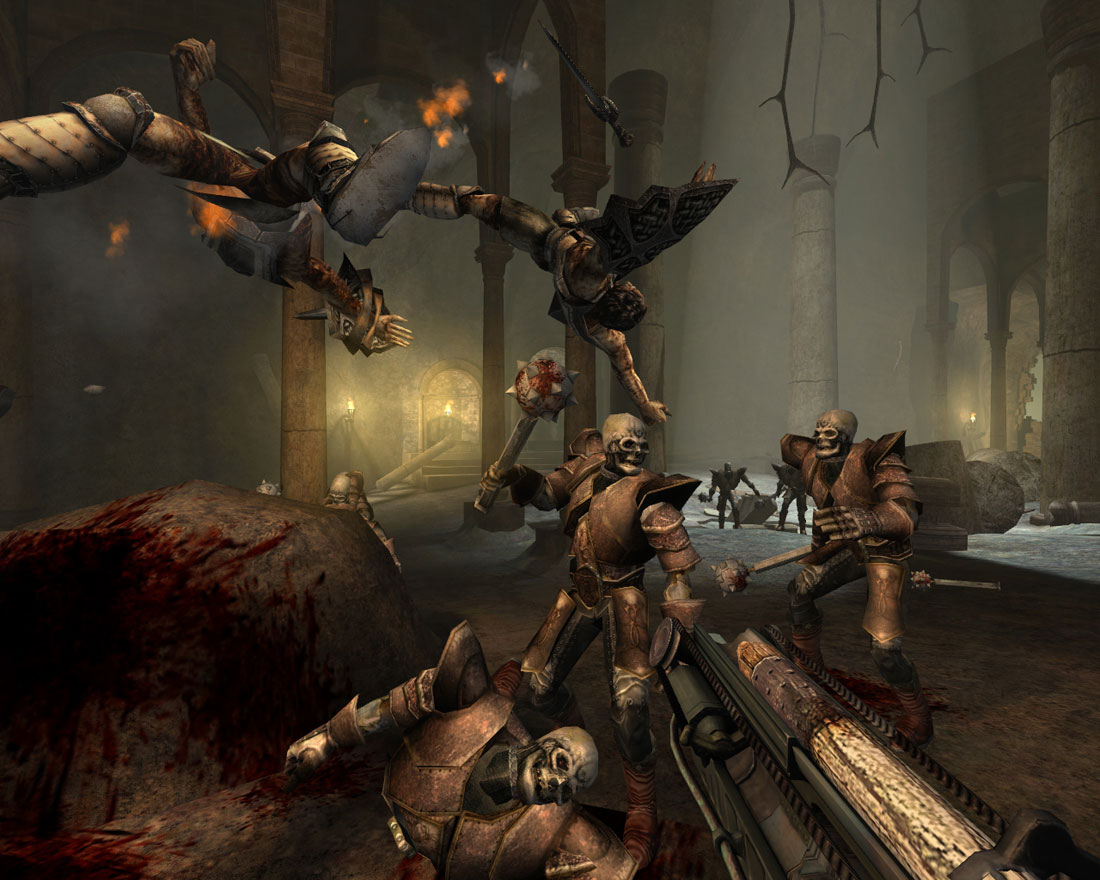
In a large number of action titles, you will be moving along a path and come across a space specifically design for a set piece to happen in.  An example of this can be Gears of War, where the abundance of chest-high walls will usually signify the approach of an incoming battle.  The player moves into this space aware of what they are looking to experience, readying their senses and acting accordingly.  They battle through this set-piece then find themselves moving along another path into the next conflict which will most likely follow the same pattern, regardless of size or prestige shifts between them.  Other examples such as a large open space with weapons littered around to signify an incoming boss battle or the more direct transitions in a game like Painkiller which feature an ongoing series of checkpoints can differ massively architecturally, but still give a similar impression to the player.  It shows that the environment can be a grand vista of physics and high-end graphical effects or simply rendered street but as long as the content aligns with the player’s desire for an experience in a well versed way it can be a great thing.  Referring back to Painkiller, some the environments may look quite simple, but its deliverance of content puts it low on the player’s priority of thoughts. 

Painkiller primarily is a series of arenas, but focuses heavily on combat to create an experience the player is looking for.  Image from http://www.nvidia.co.uk/ accessed 06/07/2015


To conclude, architecture can be a grand monument as much as a hovel but creation of an experience is what makes it truly shine.  Games do this brilliantly and it shows that chest-high wall galleries can be fun if the experience is attuned alongside it.  A game where the world around me is exploding into a million little events like Bulletstorm or Wolfenstein: the New Order can give me the same feeling of an experience as a puzzle in Antechamber due to their means of presenting the game-play to the player.  


References:
*Bataille G Archtiecture as shown in Leach, N. Rethinking Architecture(2008).  Routledge, London p.p. 20-23